

For Mother’s Day, I thought I’d turn to the New Jersey side of our Backus heritage in the person of one of New Jersey’s most colorful colonial figures, Penelope Stout, my generation’s 9th great-grandmother and one of our original immigrant ancestors – though from where she emigrated from is up for debate.
Dubbed “The Mother of Monmouth County”, Penelope Stout’s story was already a well-known tale when it appeared in print in Samuel Smith’s 1765 History of New Jersey. “Around the time of the Indian war in New England” – presumably the Pequot War – a Dutch vessel sailing from Old Amsterdam to New Amsterdam was stranded on Sandy Hook beach in what would later become New Jersey. The passengers disembarked safely and, fearing an attack by the native inhabitants, fled quickly to New Amsterdam, leaving behind one of their members who was too sick to travel, and the wife who stayed behind to care for him.
The anticipated attack soon came. The man was killed, and the woman was also cut down and left for dead. Somehow she had the strength to drag herself into a hollow log where she clung to life “by eating the excrescences that grew from it” and drinking rain water, until finally she was discovered by two Indians. An argument broke out between them to determine her fate – the younger wanting to dispatch her on the spot, and the elder disagreeing. Age and wisdom prevailed, and they carried her back to their tribe to the spot that would later become Middletown, New Jersey. The elderly Indian cared for her wounds and brought her back to health, and the tribe allowed her to live among them.
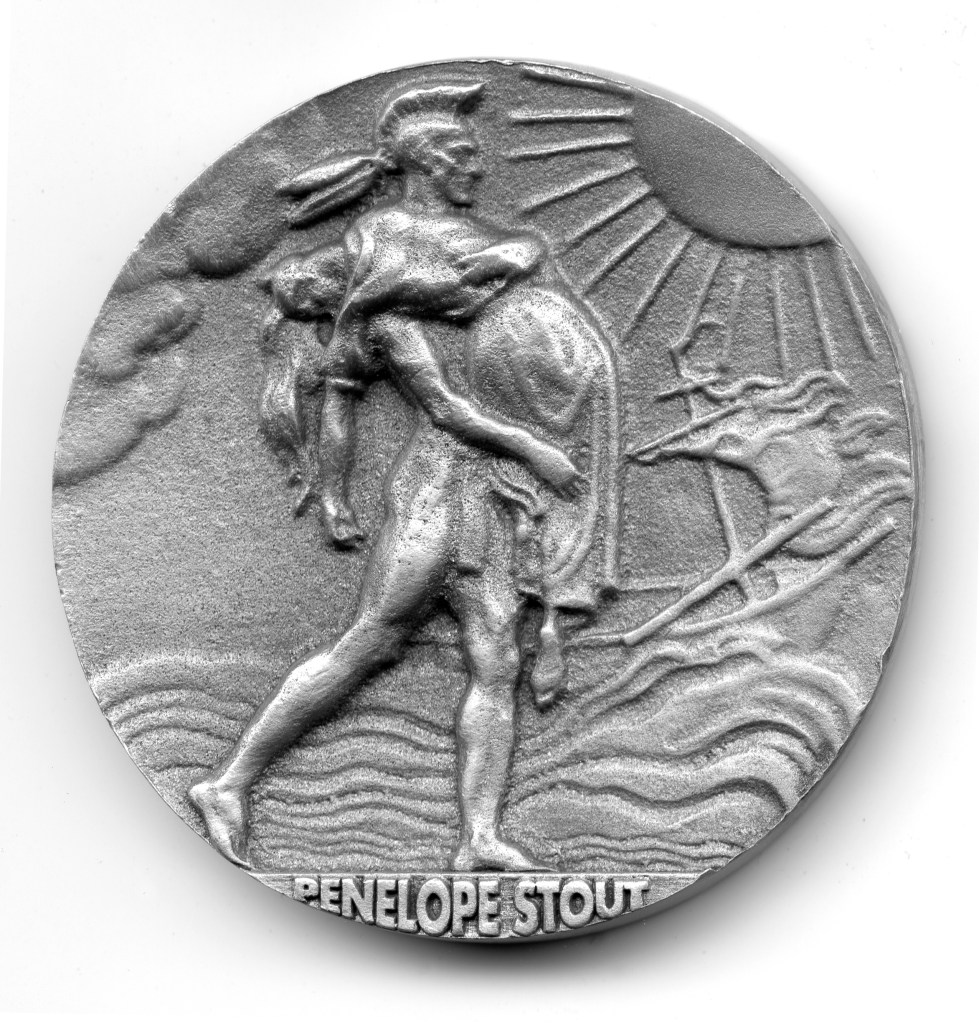
Rumors eventually reached New Amsterdam of a European living with the natives to the south, and putting two and two together, the Dutch figured out who it must be and put a party together to retrieve her. The woman was given a choice by her Indian rescuer to stay with the Indians or go back to her own people. She chose to go with her countrymen to New Amsterdam, where she married an Englishman named Stout.
Eventually she and her husband – perhaps at the behest of the wife – settled with a number of other colonists in the same area where she had lived with the natives. It was there that her native benefactor saved her once again – he warned her that his tribe was preparing to attack and slaughter the colonists – and he gave her the option of escaping with her children in a canoe he would provide. She told her husband about the warning, stressing that the old Indian had never deceived her. He, in turn, warned the rest of the colony. The colonists confronted the tribe with a show of force and managed to dissuade them from violence. The new colony of Middletown grew and flourished, and the Stouts went on to have 10 children in total, and many descendants throughout New Jersey.
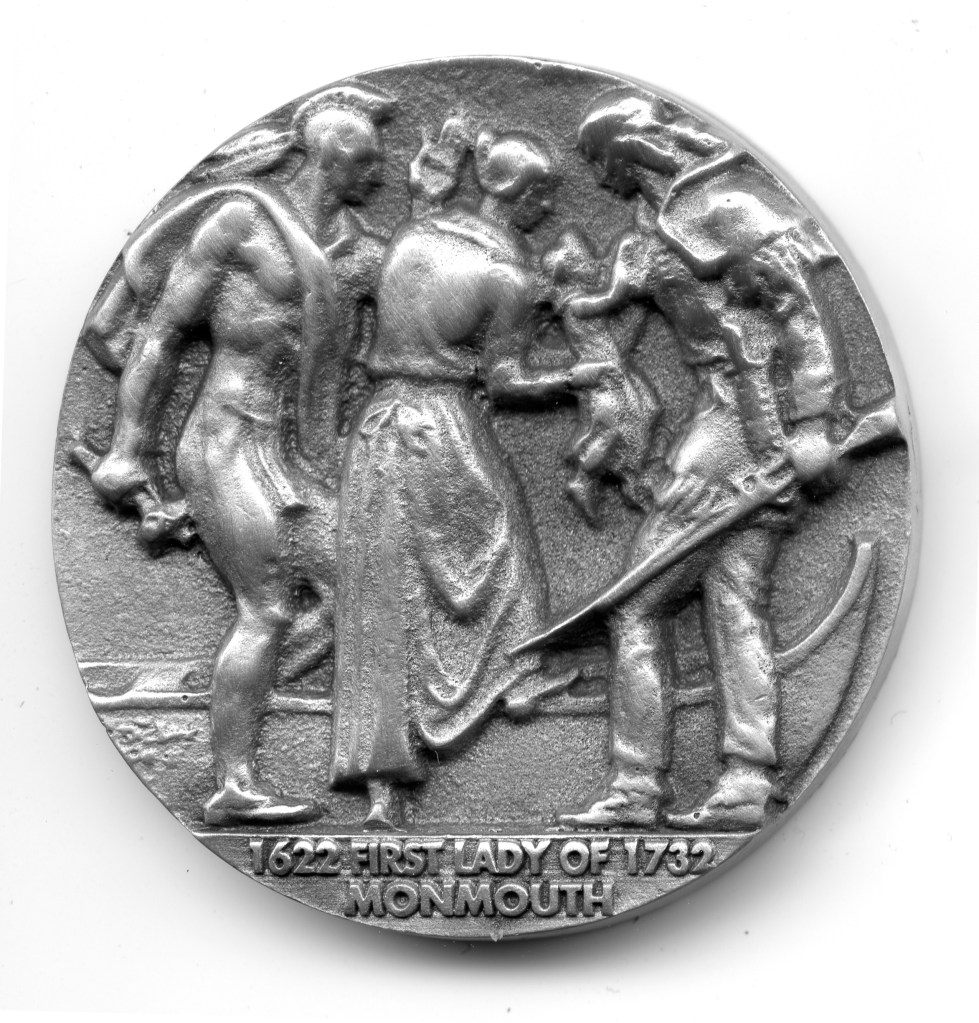
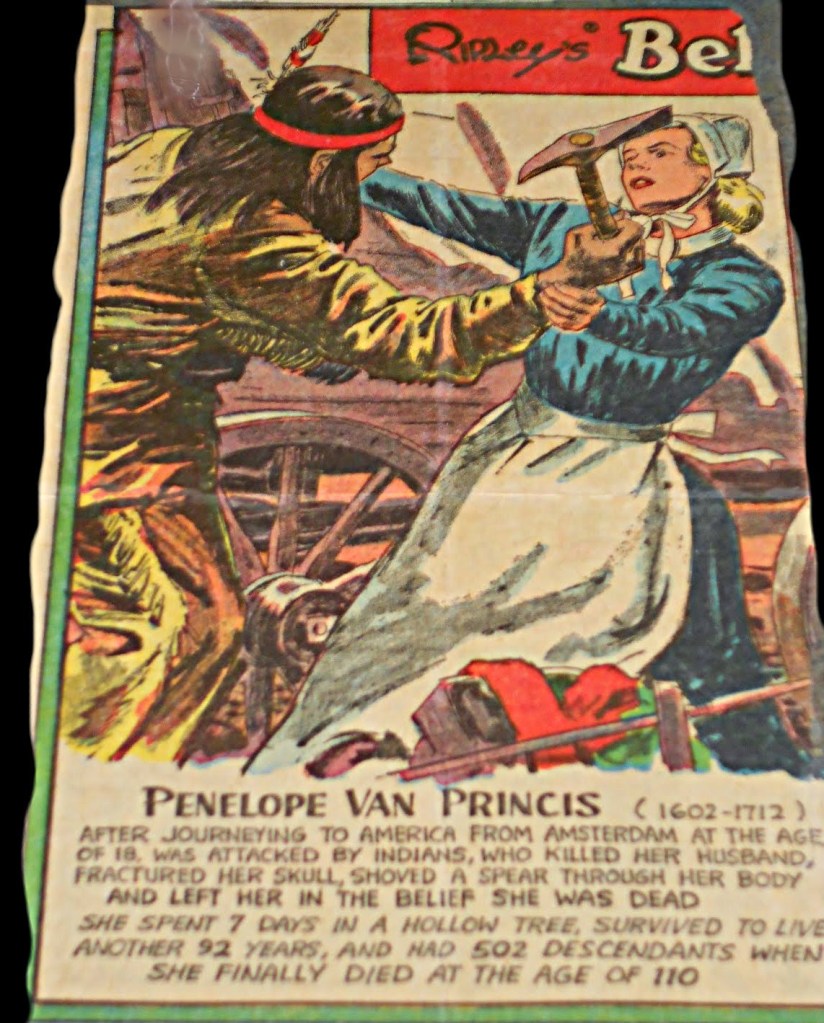
There have been more than twenty retellings of the incredible story of Penelope Stout since it first appeared in 1765 (already more than a 100 years since the events are reputed to have taken place), and most have added either changes, or more details and embellishments. A 1792 version has the elderly Indian bringing her to New Amsterdam himself, and informs us that she married at the age of 22 and lived to the venerable age of 110, with a seemingly impossible 502 descendants by the time of her death. By 1813 we learn her first name – Penelope – and we learn she was born in 1602 (putting the incident at the very founding of New Amsterdam, if not before). We also learn her maiden name is Vanprincis, and we get more gruesome details about her injuries:
“They had not been long left before the Indians came upon them and killed them as they thought, and stripped them of their garments. However, Penelope revived, although her skull was fractured and her left shoulder so injured that she was never able to use it like the other, besides she was so cut across the body that her bowels protruded, and she was obliged to keep her hand upon the wound.”
An 1876 retelling sets the incident much later – at the end of the 17th century (and some twenty years after New Amsterdam became New York). In this version, the entire group of passengers are massacred by the Indians, and it is the head of the tribe that decides to spare Penelope. In 1890, we find out that the averted attack on Middletown resulted in a lasting peace treaty and an alliance between the colonists and natives, giving the story a bit of a Thanksgiving tinge. There are many other versions and with slight discrepancies (some accounts making her the daughter of a Dutch baron, others making her an Englishwoman who originally fled to the Netherlands because of religious persecution). How much of even the basic premise of the story is true – a story passed down by word of mouth for at least a hundred years before anyone put it to paper – is impossible to tell.
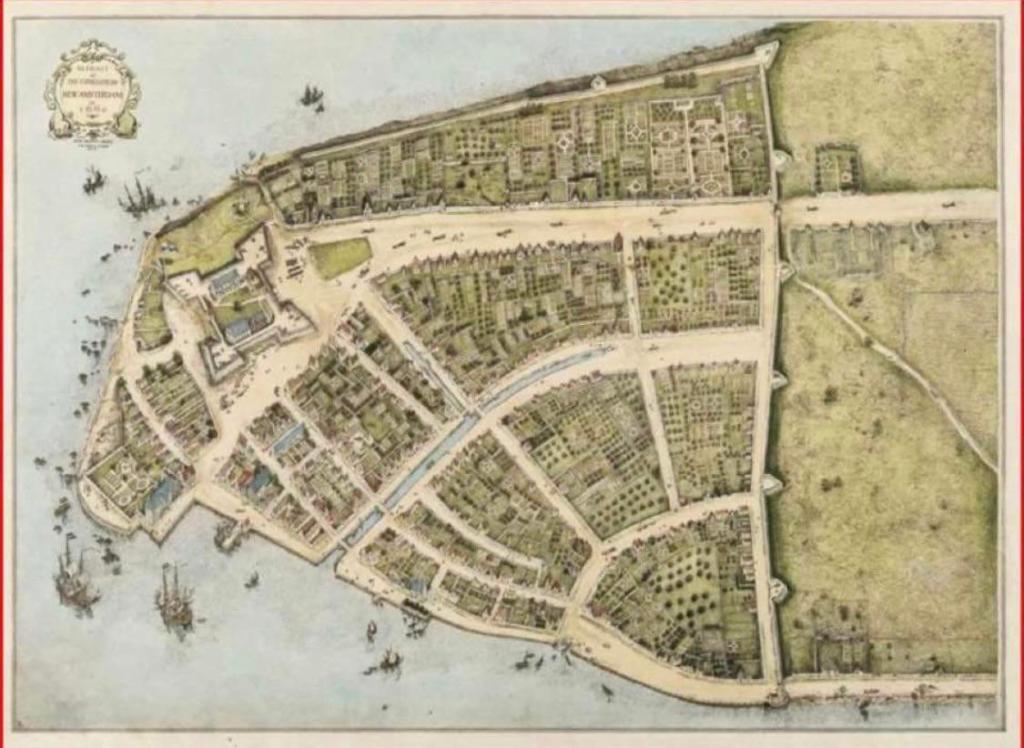
As is often the case in genealogy, we know more about Penelope’s husband. Richard Stout is likely the son of John and Elizabeth Stout of Nottinghamshire, England, and his life is a bit better documented, though not without a little romance as well – the story goes that he ran away from home because of a dispute with his parents over a love affair with a woman below his station. He then spent seven years in the British navy, finally ending up in Dutch New Amsterdam, where, in 1643, he served as a soldier for the Dutch in the bloody conflict between New Netherlands and the Lenape Indians known as Keift’s War.
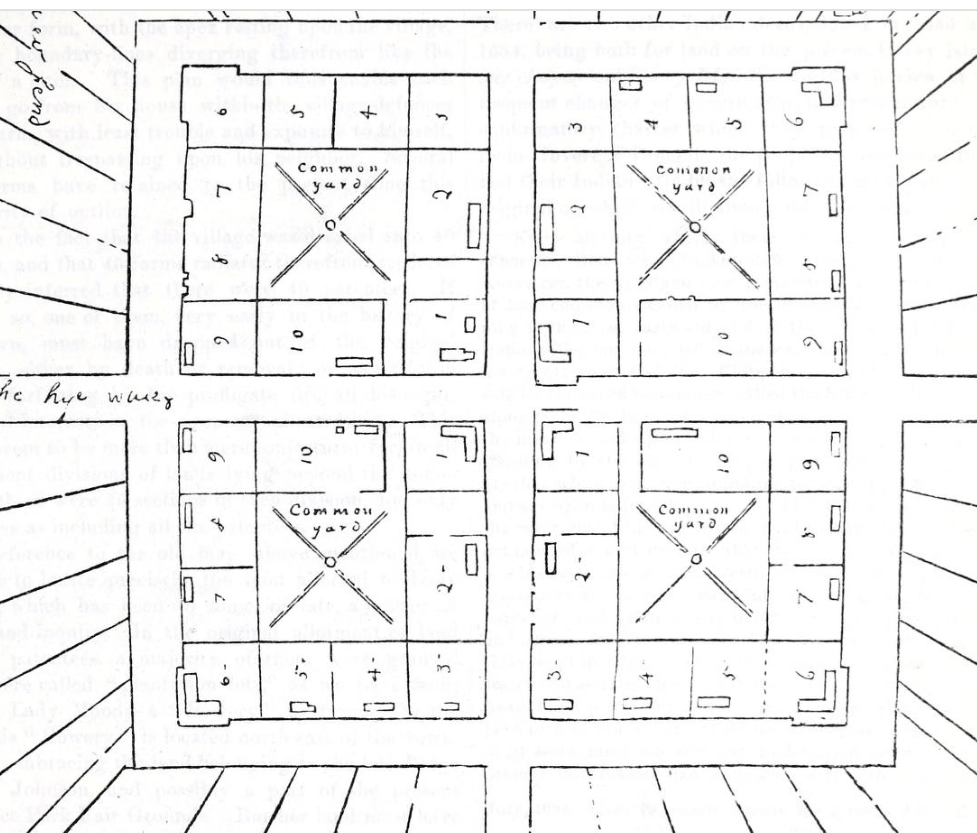
Around this time there was a group of Anabaptists in Massachusetts who were in conflict with the clergy over religious doctrine. One of their leaders, Lady Deborah Moody, was put on trial for her unorthodox belief that infants could not receive baptism, and was given the choice of changing her beliefs or excommunication. Moody chose the latter, and began negotiating with Dutch New Netherlands to start an English colony on Long Island known as Gravesend. Gravesend was the first of the original six Brooklyn villages of New Amsterdam, and the only one founded by English colonists (the others being Brooklyn Heights, Flatlands, Flatbush, New Utrecht, and Bushwick); it was also the only European colonial settlement in North America founded by a woman. Stout, already in New Amsterdam, joined them as one of the original proprietors as the owner of “Plot 18”. The neighborhood of Gravesend still exists in Brooklyn, just north of Coney Island.

We know that Richard Stout married a woman named Penelope, and they likely married around 1645 when the Gravesend colony was established. If traditional accounts are right about her being 22 when she was married, that would make her birthdate around 1622, and the incident of her time with Indians would likely have taken place around 1640, right after the Pequot War and before the founding of Gravesend. We also know conclusively that Richard and Penelope Stout were among the founders of Middletown, whose patent was granted in 1664 shortly after the English takeover of New Netherlands, making them among the earliest colonists of New Jersey. Though illiterate, Richard Stout rose to some prominence, and he became a very prosperous landowner – in 1675 he deeded 1800 acres to his various heirs. His will was proved in 1705 and his wife was named in it, so Penelope Stout died sometime after that.
Did Penelope Stout live to 110 years old? There’s no record of her death, but it seems likely that her advanced age might have been an attempt to reconcile the 1705 probate of Richard Stout’s will with her almost certainly erroneously recorded birthdate of 1602. Was she Dutch? That, too, might have been a way to explain her supposed appearance in the area in the 1620s, long before there were English settlements in the region.
As for the legend itself, if you find it too fantastic to be believed, well, there’s no evidence to support it other than long-standing oral traditions, and much that seems rather implausible. If, on the other hand, you choose to believe this extraordinary tale of hardship, bravery, kindness, and adventure, well, there’s nothing to disprove it either.
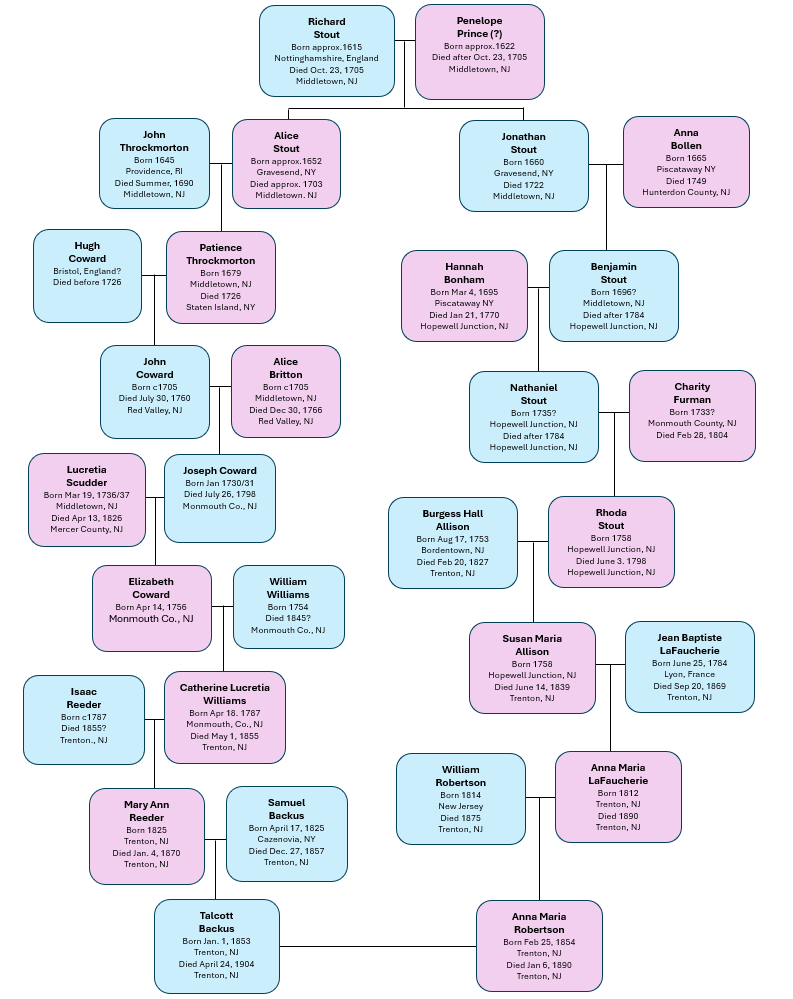
What we do know is that Richard and Penelope Stout did exist, and that the pair have a huge number of descendants. These include at least two of our own New Jersey ancestors on the Backus side of the family. Richard and Penelope’s daughter Alice married John Throckmorton in 1670, the son of another of the original Middletown patentees, and was a direct ancestor of Talcott Backus (1853-1904) on his mother’s side. Talcott’s wife, Anna Maria Robertson (1854-1890), was a direct descendant of Jonathan Stout, Richard and Penelope’s fifth son. The two married in Trenton, New Jersey in 1876, uniting their shared New Jersey ancestry less than fifty miles – but over 200 years and over countless retellings of the Penelope Stout legend – from where and the “Mother of Monmouth County” is said to have first set foot on the Jersey Shore.

 The Great Oak