For Mother’s Day, I thought I’d turn to the New Jersey side of our Backus heritage in the person of one of New Jersey’s most colorful colonial figures, Penelope Stout, my generation’s 9th great-grandmother and one of our original immigrant ancestors – though from where she emigrated from is up for debate.
Dubbed “The Mother of Monmouth County”, Penelope Stout’s story was already a well-known tale when it appeared in print in Samuel Smith’s 1765 History of New Jersey. “Around the time of the Indian war in New England” – presumably the Pequot War – a Dutch vessel sailing from Old Amsterdam to New Amsterdam was stranded on Sandy Hook beach in what would later become New Jersey. The passengers disembarked safely and, fearing an attack by the native inhabitants, fled quickly to New Amsterdam, leaving behind one of their members who was too sick to travel, and the wife who stayed behind to care for him.
The anticipated attack soon came. The man was killed, and the woman was also cut down and left for dead. Somehow she had the strength to drag herself into a hollow log where she clung to life “by eating the excrescences that grew from it” and drinking rain water, until finally she was discovered by two Indians. An argument broke out between them to determine her fate – the younger wanting to dispatch her on the spot, and the elder disagreeing. Age and wisdom prevailed, and they carried her back to their tribe to the spot that would later become Middletown, New Jersey. The elderly Indian cared for her wounds and brought her back to health, and the tribe allowed her to live among them.
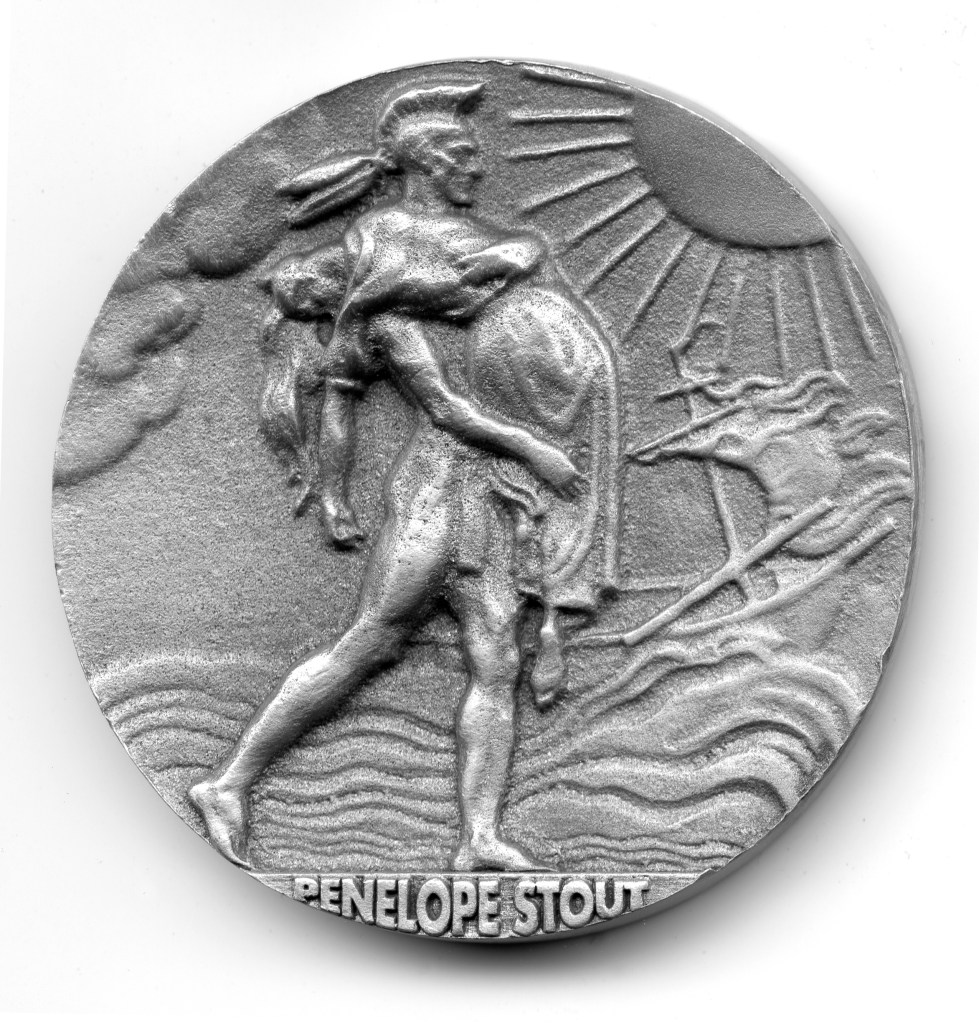
Commemorative medal depicts Penelope’s rescue.
Rumors eventually reached New Amsterdam of a European living with the natives to the south, and putting two and two together, the Dutch figured out who it must be and put a party together to retrieve her. The woman was given a choice by her Indian rescuer to stay with the Indians or go back to her own people. She chose to go with her countrymen to New Amsterdam, where she married an Englishman named Stout.
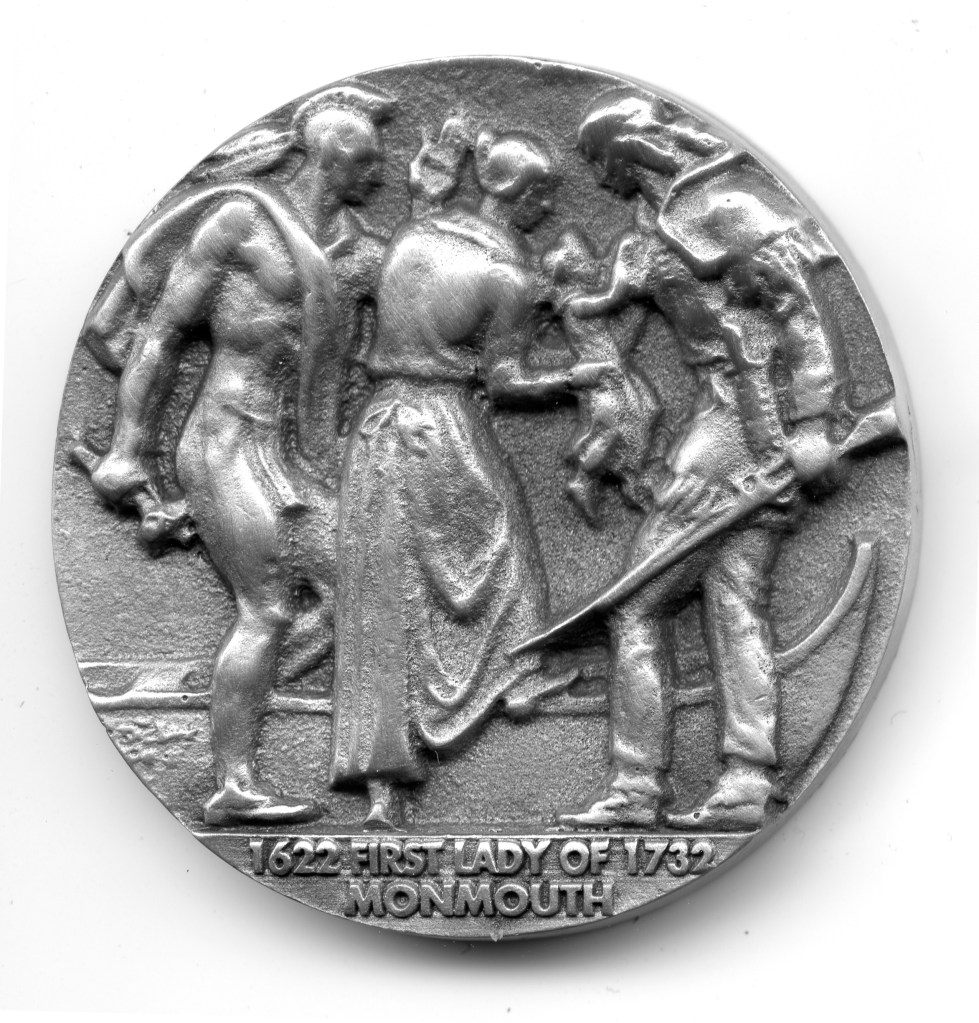
Eventually she and her husband – perhaps at the behest of the wife – settled with a number of other colonists in the same area where she had lived with the natives. It was there that her native benefactor saved her once again – he warned her that his tribe was preparing to attack and slaughter the colonists – and he gave her the option of escaping with her children in a canoe he would provide. She told her husband about the warning, stressing that the old Indian had never deceived her. He, in turn, warned the rest of the colony. The colonists confronted the tribe with a show of force and managed to dissuade them from violence. The new colony of Middletown grew and flourished, and the Stouts went on to have 10 children in total, and many descendants throughout New Jersey.
Commemorative medal depicting Stout’s rescuer returning to warn her of an imminent attack.
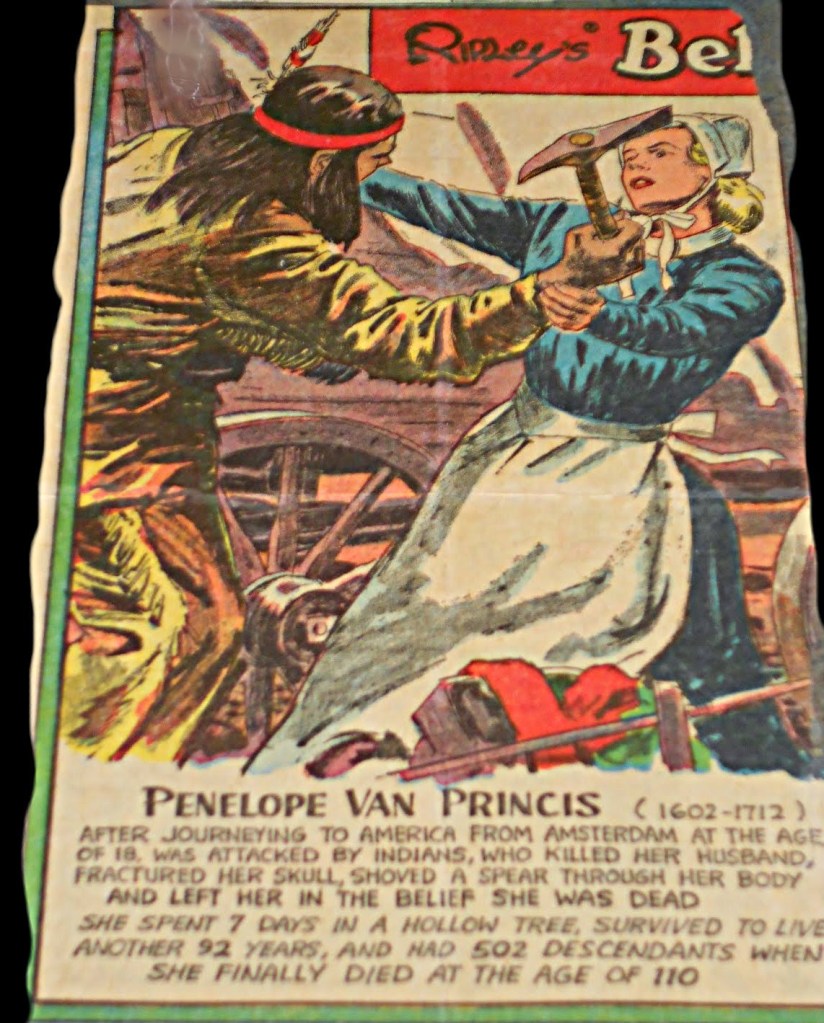
There have been more than twenty retellings of the incredible story of Penelope Stout since it first appeared in 1765 (already more than a 100 years since the events are reputed to have taken place), and most have added either changes, or more details and embellishments. A 1792 version has the elderly Indian bringing her to New Amsterdam himself, and informs us that she married at the age of 22 and lived to the venerable age of 110, with a seemingly impossible 502 descendants by the time of her death. By 1813 we learn her first name – Penelope – and we learn she was born in 1602 (putting the incident at the very founding of New Amsterdam, if not before). We also learn her maiden name is Vanprincis, and we get more gruesome details about her injuries:
“They had not been long left before the Indians came upon them and killed them as they thought, and stripped them of their garments. However, Penelope revived, although her skull was fractured and her left shoulder so injured that she was never able to use it like the other, besides she was so cut across the body that her bowels protruded, and she was obliged to keep her hand upon the wound.”
An 1876 retelling sets the incident much later – at the end of the 17th century (and some twenty years after New Amsterdam became New York). In this version, the entire group of passengers are massacred by the Indians, and it is the head of the tribe that decides to spare Penelope. In 1890, we find out that the averted attack on Middletown resulted in a lasting peace treaty and an alliance between the colonists and natives, giving the story a bit of a Thanksgiving tinge. There are many other versions and with slight discrepancies (some accounts making her the daughter of a Dutch baron, others making her an Englishwoman who originally fled to the Netherlands because of religious persecution). How much of even the basic premise of the story is true – a story passed down by word of mouth for at least a hundred years before anyone put it to paper – is impossible to tell.
As is often the case in genealogy, we know more about Penelope’s husband. Richard Stout is likely the son of John and Elizabeth Stout of Nottinghamshire, England, and his life is a bit better documented, though not without a little romance as well – the story goes that he ran away from home because of a dispute with his parents over a love affair with a woman below his station. He then spent seven years in the British navy, finally ending up in Dutch New Amsterdam, where, in 1643, he served as a soldier for the Dutch in the bloody conflict between New Netherlands and the Lenape Indians known as Keift’s War.
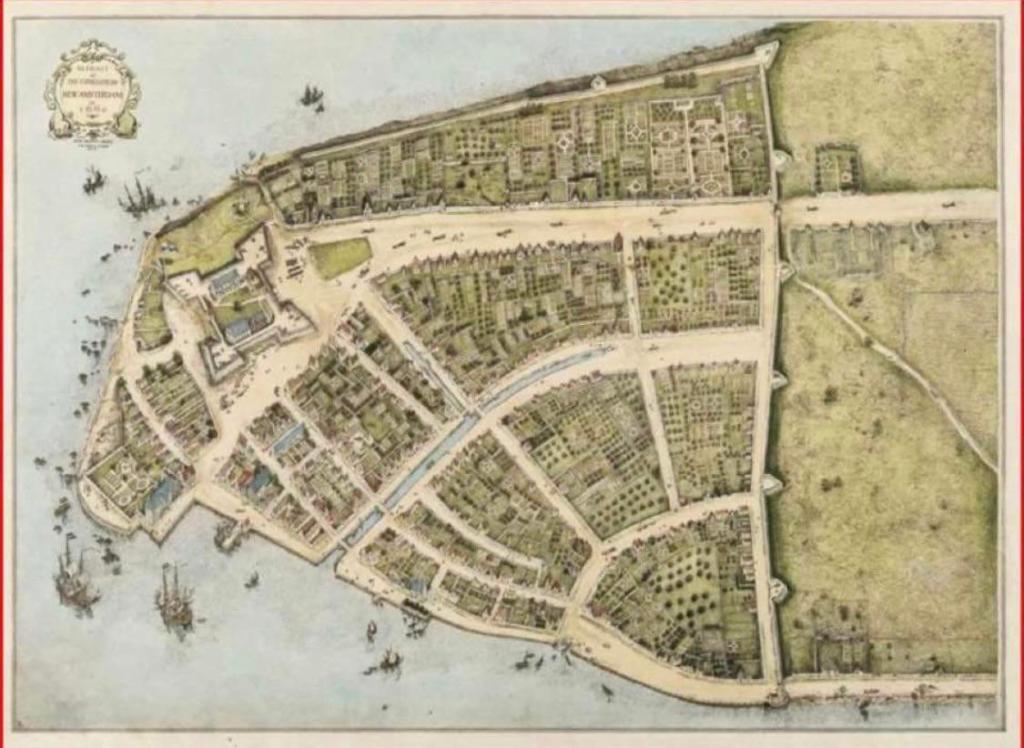
Dutch New Amsterdam in the 1640s, around the time the wall at Wall Street was built.
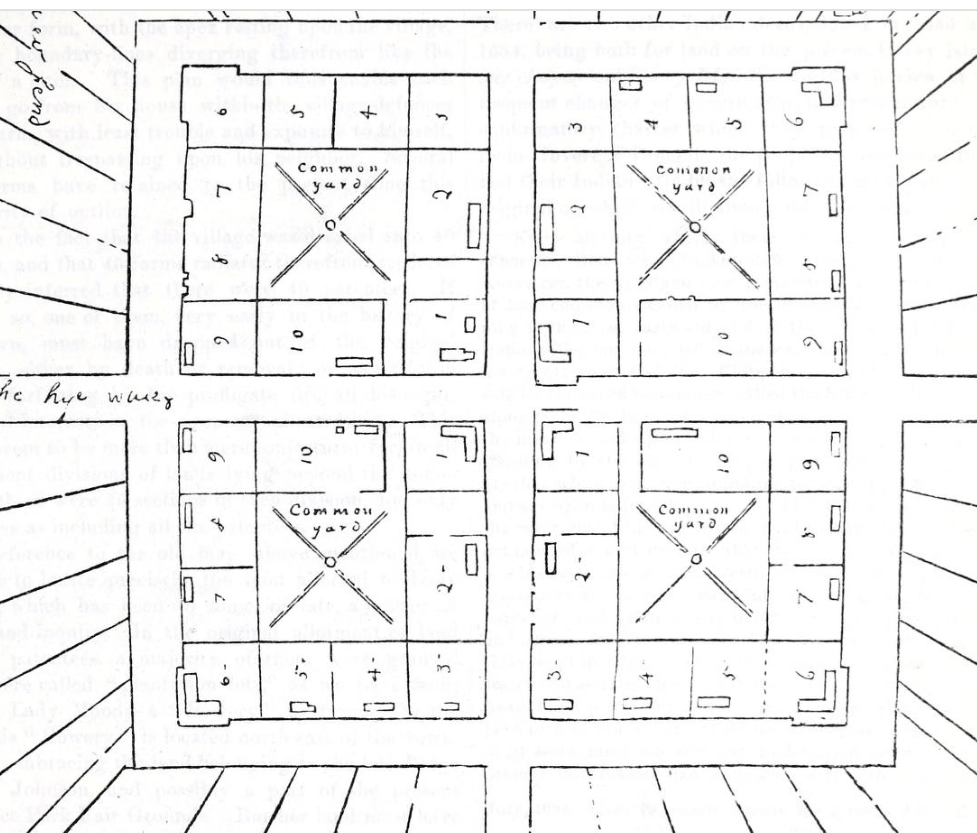
Around this time there was a group of Anabaptists in Massachusetts who were in conflict with the clergy over religious doctrine. One of their leaders, Lady Deborah Moody, was put on trial for her unorthodox belief that infants could not receive baptism, and was given the choice of changing her beliefs or excommunication. Moody chose the latter, and began negotiating with Dutch New Netherlands to start an English colony on Long Island known as Gravesend. Gravesend was the first of the original six Brooklyn villages of New Amsterdam, and the only one founded by English colonists (the others being Brooklyn Heights, Flatlands, Flatbush, New Utrecht, and Bushwick); it was also the only European colonial settlement in North America founded by a woman. Stout, already in New Amsterdam, joined them as one of the original proprietors as the owner of “Plot 18”. The neighborhood of Gravesend still exists in Brooklyn, just north of Coney Island.
Original plots of Gravesend, History of the Town of Gravesend, NY
Gravesend in 2024, the grid of the original plots can still be seen.
We know that Richard Stout married a woman named Penelope, and they likely married around 1645 when the Gravesend colony was established. If traditional accounts are right about her being 22 when she was married, that would make her birthdate around 1622, and the incident of her time with Indians would likely have taken place around 1640, right after the Pequot War and before the founding of Gravesend. We also know conclusively that Richard and Penelope Stout were among the founders of Middletown, whose patent was granted in 1664 shortly after the English takeover of New Netherlands, making them among the earliest colonists of New Jersey. Though illiterate, Richard Stout rose to some prominence, and he became a very prosperous landowner – in 1675 he deeded 1800 acres to his various heirs. His will was proved in 1705 and his wife was named in it, so Penelope Stout died sometime after that.
Did Penelope Stout live to 110 years old? There’s no record of her death, but it seems likely that her advanced age might have been an attempt to reconcile the 1705 probate of Richard Stout’s will with her almost certainly erroneously recorded birthdate of 1602. Was she Dutch? That, too, might have been a way to explain her supposed appearance in the area in the 1620s, long before there were English settlements in the region.
As for the legend itself, if you find it too fantastic to be believed, well, there’s no evidence to support it other than long-standing oral traditions, and much that seems rather implausible. If, on the other hand, you choose to believe this extraordinary tale of hardship, bravery, kindness, and adventure, well, there’s nothing to disprove it either.
Penelope Van Princis in the Ripley’s Believe It or Not comic book.
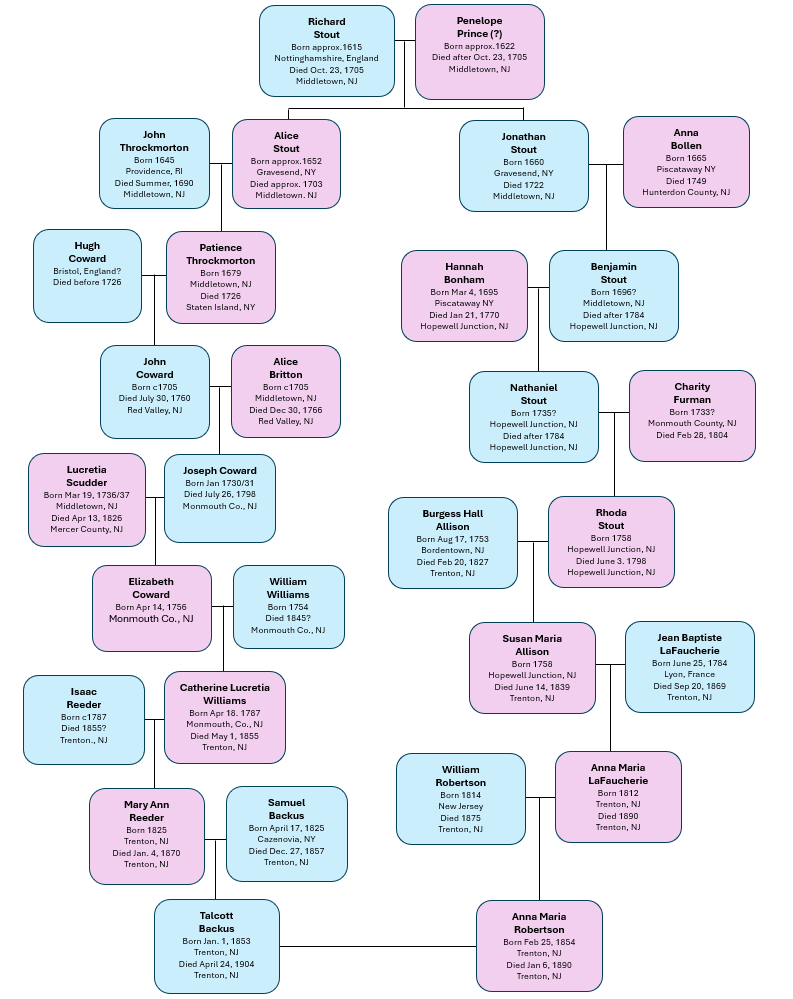
What we do know is that Richard and Penelope Stout did exist, and that the pair have a huge number of descendants. These include at least two of our own New Jersey ancestors on the Backus side of the family. Richard and Penelope’s daughter Alice married John Throckmorton in 1670, the son of another of the original Middletown patentees, and was a direct ancestor of Talcott Backus (1853-1904) on his mother’s side. Talcott’s wife, Anna Maria Robertson (1854-1890), was a direct descendant of Jonathan Stout, Richard and Penelope’s fifth son. The two married in Trenton, New Jersey in 1876, uniting their shared New Jersey ancestry less than fifty miles – but over 200 years and over countless retellings of the Penelope Stout legend – from where and the “Mother of Monmouth County” is said to have first set foot on the Jersey Shore.
Talcott Backus and Anna Maria Robertson, both Stout descendants, were married in Trenton, NJ in 1876.
November is Native American Heritage Month, which seems as good a time as to address, at least in part, the role our ancestors played in the treatment of the Native American people who were already living in New England before they arrived. Growing up, talk of conflicts between Europeans and American Indians for me at least evoked cavalry charges against Souix warriors galloping across the Great Plains, whereas New England conjured up scenes of smiling people with feathers in their hair and buckles on their hats exchanging corn and pies in a quaint display of cultural appreciation.
In fact, seventeenth century colonial New England witnessed two bloody wars between the colonists and the indigenous population. The first of these – the Anglo-Pequot War of 1636 to 1638 – took place in Connecticut, and was the very first large-scale conflict between English colonists and the indigenous people of North America north of Mexico. At least two of our ancestors were directly involved in one particular watershed event that was once commonly called the Battle of Mystic Fort, but is now more often – and more appropriately – known as the Mystic Massacre. This event made possible the colonization of Connecticut and set the stage for the expansion of the English colonies in New England. Some historians and legal scholars have also argued that the event, and what subsequently befell the Pequots, qualifies as genocide.
Thomas Hooker and the founding of Hartford
When our immigrant ancestor William Backus arrived in Saybrook sometime in the 1640s, he was a relative latecomer when it came to the first wave of English migration to the New World.
Most English families arrived earlier during a massive wave of English immigration that took place in the 1630s known as the Great Migration, which saw the arrival of about 20,000 settlers from England between 1630 and 1640. These immigrants were largely puritans seeking to escape the religious persecution of Charles I. By the 1640s this migration was largely halted when the puritans stopped fleeing and started fighting in the English Civil War.
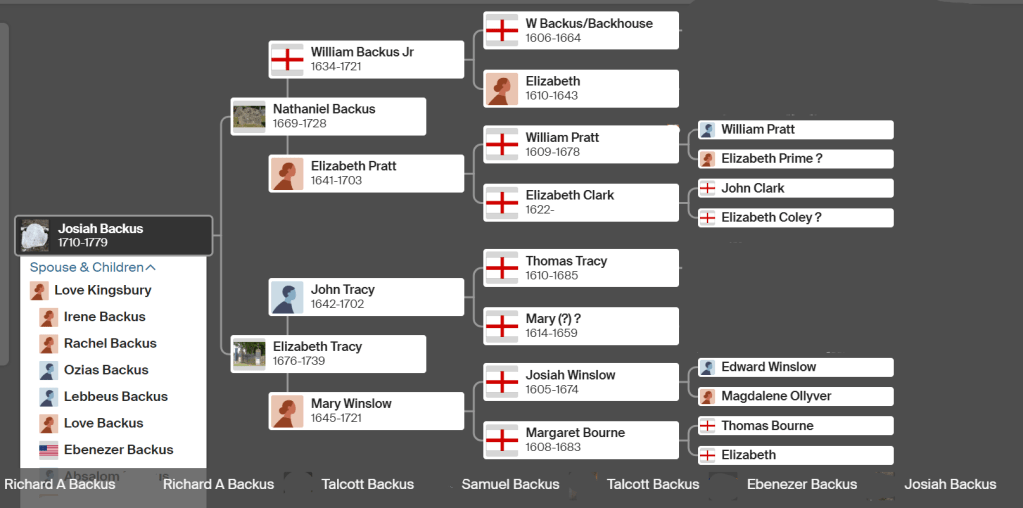
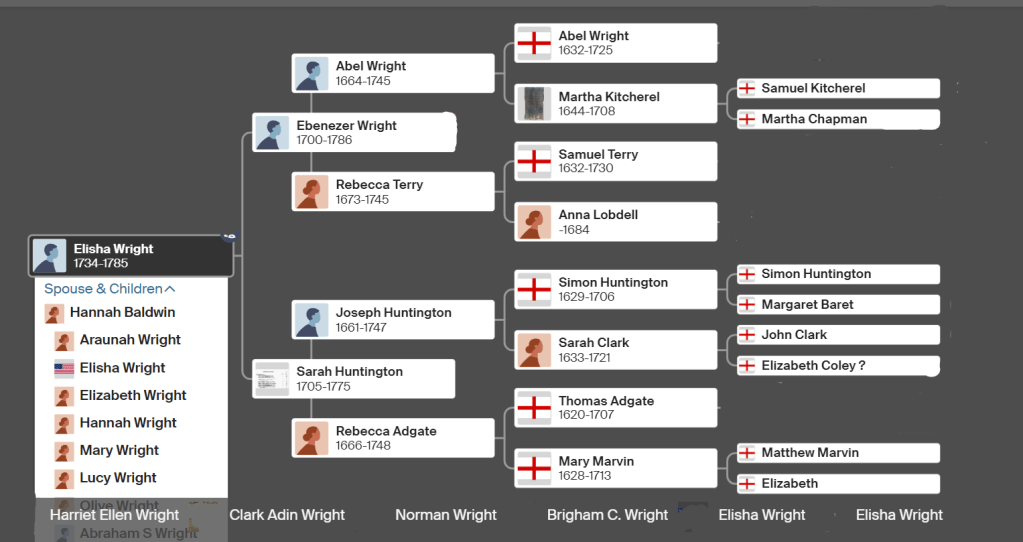
Two such ancestors were John Clark and William Pratt. Clark’s daughter, Elizabeth, married William Pratt, and their daughter Elizabeth was the second wife of William Backus, Jr – the son of the original Backus immigrant ancestor of the same name. On our Wright side of the family, John Clark is also an ancestor through another one of his daughters, Sarah. See below:
Both William Pratt and his future father-in-law John Clark hailed from County Hertfordshire in England. How they came under Puritan influence is not precisely known, though Pratt was likely the son of Reverend William Pratt of Stevenage, who studied at Emmanuel College in Cambridge, a hotbed of Puritan theology where two of the most influential New England theologians studied, John Cotton and Thomas Hooker. It was Hooker who Clark and Pratt would ultimately tie their fortunes to when both men emigrated to the recently established Massachusetts Bay Colony. We know Clark arrived in Massachusetts in 1632 – possibly on the Griffin with Cotton and Hooker – and Pratt likely arrived in 1633.
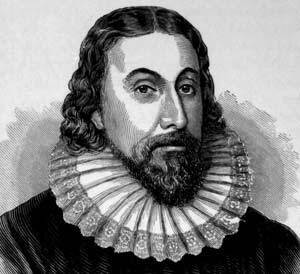
Thomas Hooker
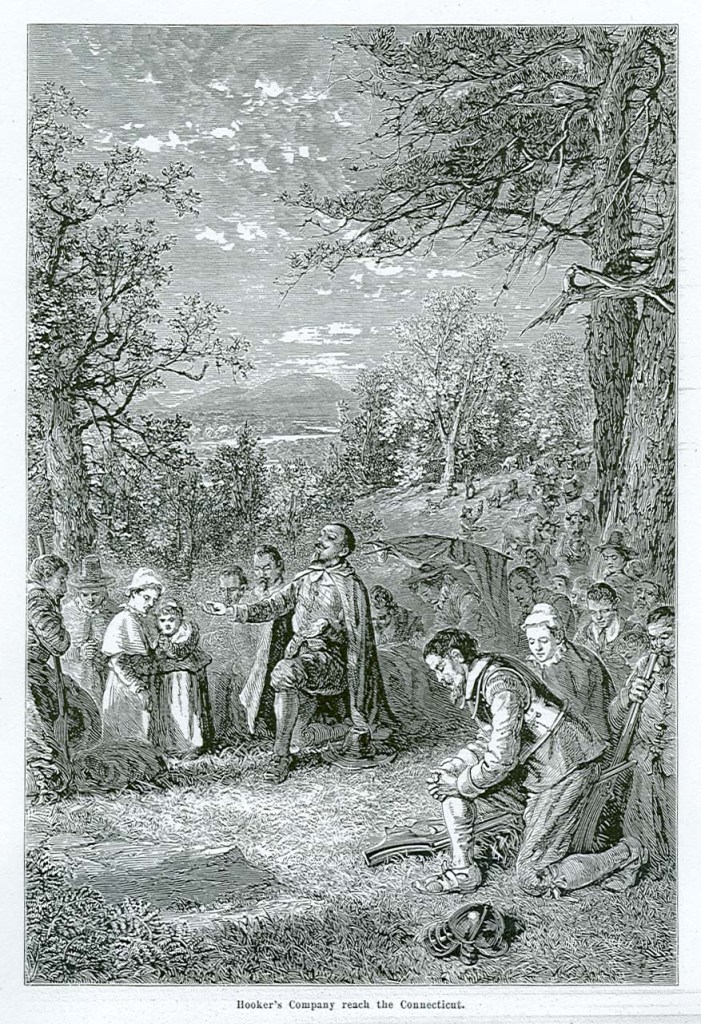
Once in New England, Cotton and Hooker fell out with each other over suffrage rights in the colony: Cotton maintained that only full-fledged members of the church should be allowed to vote – and then only after a rigorous religious examination – while Hooker wanted suffrage to be extended to all Christians (needless to say, no one entertained the idea of non-Christians being a part of this new society). This dispute led Hooker to lead a group of about a hundred colonists inland to found a new settlement on the Connecticut River in 1635. Both Clark and Pratt would join this group shortly thereafter, and all three would become founders of Hartford, the city that would become the center of the Connecticut Colony and the current state capitol.
The Pequots
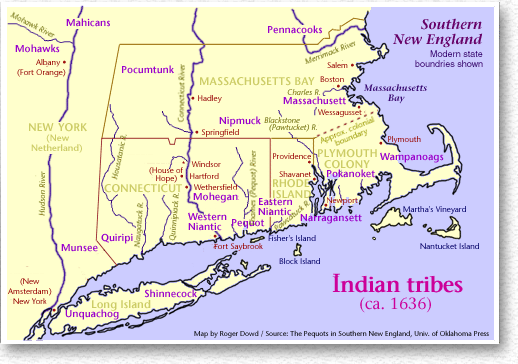
Standing in the way of this colonial destiny was the fact that people had been living in Connecticut for thousands of years before the arrival of European colonists. When the English started to make their way into central Connecticut, the region was dominated by the Pequots, who were centered in Eastern Connecticut but had recently subjugated most of the other tribes around them. Also preceding the English in the region were the Dutch, who, moving west from New Amsterdam, had already established a trade agreement with the Pequots and a fort directly across the river from Hartford (idyllically named Huys de Hoop or “House of Hope”). The Dutch were there for trade – specifically to expand their control of the North American fur trade which had been so lucrative for them in the Hudson River valley.
Relations between the English colonists and the Pequots got off on the wrong foot when either the Pequots or one of their tributary tribes killed an English trader named John Stone. The Pequots tried to smooth arrangements with the English, which resulted in a trade agreement between the Pequots and the Massachusetts Bay Colony, and which allowed for the establishment of the Connecticut River colonies of Windsor (1633), Wethersfield (1634), and Hartford (1635). Although negotiations over the death of Stone never were resolved, things seemed to be on the upswing for Ango-Pequot relations, and the Massachusetts Bay Colony even managed to secure a peace treaty between the Pequots and their regional enemies to the east, the Narragansetts.
Hostilities Begin
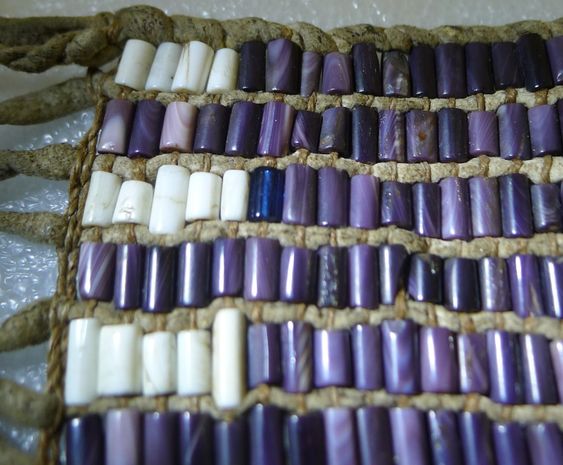
But peaceful coexistence was not to be. The pressure created by the rapidly increasing number of English immigrants into North America – and the land and lucrative trade that the Pequots stood in the way of – made conflict inevitable, beginning a cycle that would be repeated over and over again over the next two hundred and fifty years of American history. The rapid increase in the population of the colonists made the largely uncolonized region of Connecticut appealing, but the Pequots controlled more than just the land. Because of their domination of the Connecticut coast, the Pequots also largely controlled the manufacture of wampum, jewelry created from white and black shells gathered from the Long Island Sound. Wampum was instrumental in trading for fur with Native American tribes in the interior. The importance and value of wampum, and the control of its production, is evident by the Massachusetts Bay Colony declaring it a form of legal tender in 1637 valued at six beads a penny.
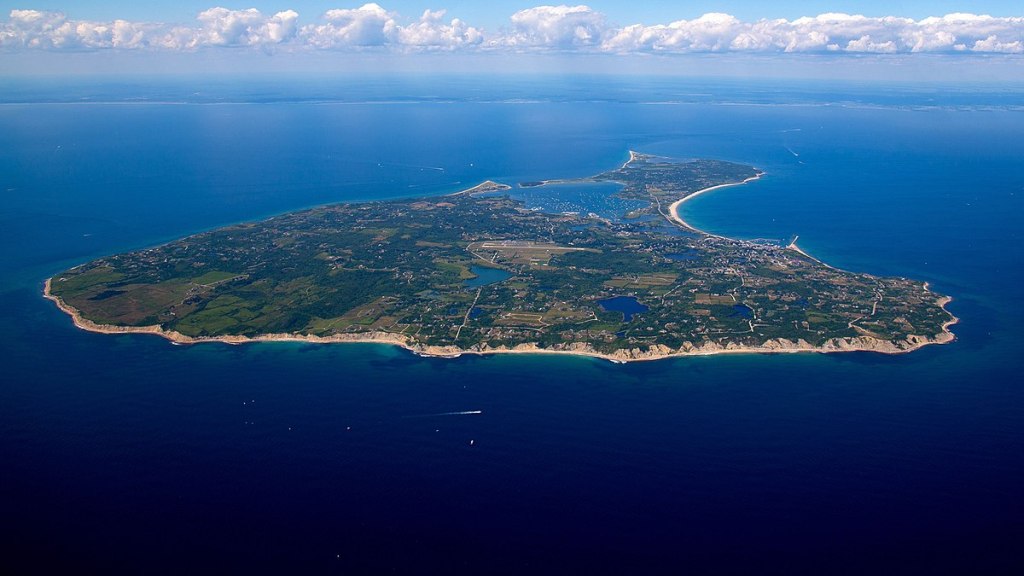
The triggering event was the murder of another English trader, John Oldham, in 1636 by the native inhabitants of Block Island. Block Island was Narragansett territory, enemies of the Pequots to the east in what is now Rhode Island, and the Narragansetts swiftly sent a delegation to Boston to assuage the colonists, pay restitution, protest the innocence of the Narragansett chiefs, and declare that the true perpetrators of the murder were being given refuge by the Pequots. In response, the government of Massachusetts sent out a fleet of small vessels carrying a force of 90 armed men under the command of John Endicott – despite the fact that there was no real evidence of Pequot culpability in Oldham’s murder.
Endicott’s specific orders were first to sail to Block Island, slaughter all of the adult men there, seize the women and children, and then claim the Island for Massachusetts. All didn’t go according to plan, however, as the natives escaped and hid in the swamps, so Endicott’s men had to satisfy themselves with burning down the village and its crops, staving the canoes out to sea, and shooting some of their dogs. Their next order of business was to go to the Pequots and demand they hand over the murderers of John Stone two years earlier along with “other English” and either one thousand fathoms of wampum or twenty of their children as hostages until the restitution could be paid (the fact that Oldham wasn’t even mentioned by name indicates how flimsy the immediate provocation on Block Island was when it came to confronting the Pequots.) Arriving in Connecticut, Endicott gave his ultimatum and waited as the Pequots stalled for time while they slipped away. With the natives eluding him, Endicott had to once again content himself with ravaging the country and burning their crops. He then returned to Boston.
Block Island
Endicott’s expedition was met with little enthusiasm from the colonists in Connecticut, for they correctly understood that they, rather than Massachusetts, would bear the brunt of the Pequot retaliation. This came to pass: the Pequots commenced a series of attacks on English settlers in Connecticut and besieged Fort Saybrook. Realizing this was going to be serious business, the Pequots also sent a delegation to their rivals the Narragansetts with a proposal to set aside their differences and form an alliance to drive the English from the region. The Pequots seemed to understand that they were no match for English on the open field against their guns, but they argued that they could wage a successful campaign where they would set fire to their houses, destroy their crops and livestock, and generally harass them and make their lives so miserable that they would have no choice but retreat back across the ocean from where they came from. Finally, in a moment in prescience, they appealed to the Narragansetts to realize that if the Pequots were destroyed, they themselves would not be far behind.
This delegation opens up a great “what if’s” of American history. There were probably fewer than ten thousand colonists in New England and less than a thousand colonists in Connecticut at this time, a number that would expand dramatically once the colonists had secured a stable footing in the region. Could a Pequot-Narragansett alliance have, if not driven them from the coast of Massachusetts, at least forestalled their rapid expansion westward until the Great Migration dropped down to just a trickle in the 1640s? We’ll never know for sure: though Narragansetts apparently took the Pequot proposal seriously, they were persuaded – largely at the behest of Rhode Island founder Roger Williams – to reject an alliance with their traditional enemies and side with the colonists. Thus the Pequots found themselves not only isolated, but now at war with a coalition of powers that included the Massachusetts Bay Colony, the Connecticut colonists, the Narragansett nation, and most of the tributary tribes that were eager to shake off their control.
In April 1637, the Pequots and their allies attacked the small village of Wethersfield – just about five miles south of Hartford – killing nine colonists and kidnapping two teenage girls who they hoped would be able to teach them how to make gunpowder (they couldn’t). This action roused the colonial leaders in Connecticut to take action. The three Connecticut River settlements raised a military force of 90 men (90 seems to have been the magic number for colonial military operations) in order to commence an offensive war against the Pequots. Our ancestors John Clark and William Pratt were among the forty-two men who enlisted from Hartford.
Artist Rendition of the attack on Wethersfield
The Mystic Massacre
The man leading the expedition – Captain John Mason – was a seasoned professional soldier and veteran of Europe’s Thirty Years War, serving under Sir Thomas Fairfax in some of the major battles and campaigns against the Catholics in the Netherlands during the 1620s. Mason arrived in Massachusetts in 1632, and his military expertise was quickly put to use in building a fort in Boston Harbor and commanding a small fleet to chase off the first pirate to prey on New England waters, Dixie Bull. In 1635 Mason settled in Windsor, Connecticut, becoming an obvious choice to command the military force raised by the Connecticut River colonies. In that role he would prove to be capable, efficient, and ruthless.
Joining him were seventy Native American warriors under the command of Uncas, the sachem of the Mohegans, tributaries of the Pequots who were in open rebellion against them. This combined force first marched to Fort Saybrook to relieve the siege, and there was joined by another twenty soldiers under the command of Captain John Underhill, another hardened veteran of Europe’s religious wars. Mason and Underhill recruited another 200 or so Native American allies from the Narragansetts before marching into Pequot territory, arriving at a palisaded village on the Mystic River on the evening of May 26, 1637. It seems the Native American allies were dubious of the colonists’ resolve in attacking the fearsome Pequots. In a “hold my beer” moment, Mason told his Indian allies to step back and watch, then he and his men proceeded to attack the fort right before dawn.
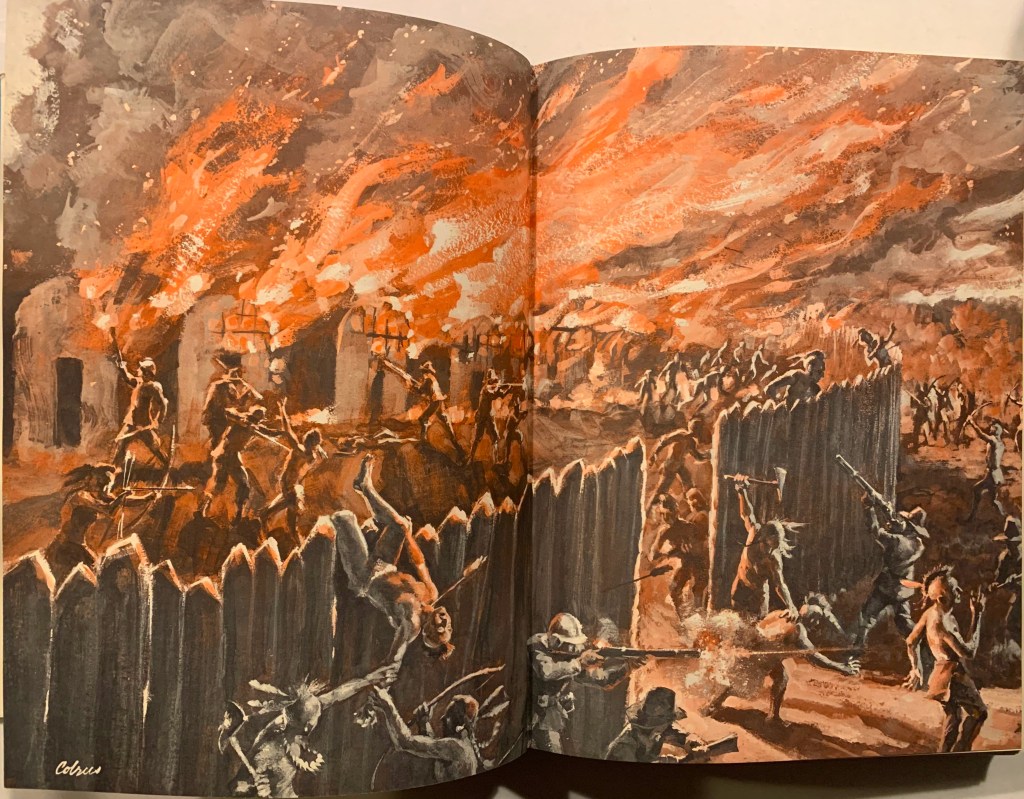
Initially, the plan was to sneak into the settlement, kill the inhabitants, and “save the Plunder”. But a barking dog alerted the sleeping Pequots to the infiltration, and only twenty colonists were able to penetrate the village before a stiff resistance was put up by the defenders. Mason, seeing his men scattered under arrow fire, then decided to try a different tactic. In his published account of the battle, Mason describes his actions in the third person:
The Captain also said, WE MUST BURN THEM; and immediately stepping into the Wigwam where he had been before, brought out a Fire-Brand, and putting it into the Matts with which they were covered, set the Wigwams on Fire.
Mason and his men withdrew and encircled the fort, with his Narragansett and Mohegan allies forming an outer ring behind them. Captain Underhill gives a description of what happened next:
many were burnt in the Fort, both men, women, and children, others forced out, and came in troopes to the Indians, twentie, and thirtie at a time, which our souldiers received and entertained with the point of the sword; downe fell men, women, and children, those that scaped us, fell into the hands of the Indians, that were in the reere of us; it is reported by themselves, that there were about foure hundred soules in this Fort, and not above five of them escaped out of our hands.
By all accounts it was a slaughter. Underhill gives the death count at 400, while Mason says it could have been as high as 700, mostly women, children, and elderly non-combatants. Only two colonists were killed in the battle. Both Mason and Underhill, probably reflecting the views of most of the colonists at the time, saw themselves as the sword of righteousness in executing God’s will.
In the words of Mason:
GOD was above them, who laughed his Enemies and the Enemies of his People to Scorn, making them as a fiery Oven…Thus did the LORD judge among the Heathen, filling the Place with dead Bodies!
And in the words of Underhill:
Why should you be so furious (as some have said) should not Christians have more mercy and compassion?…sometimes the Scripture declareth women and children must perish with their parents; some-time the case alters: but we will not dispute it now. We had sufficient light from the word of God for our proceedings.
A two-page color spread of the attack from an illustrated edition of “The Connecticut Story” by Joseph B. Hoyt, 1961
The Aftermath
After the massacre, the Pequots were on the run. The Pequot sachem Sassacus attempted to flee west with about 400 followers out of Connecticut, but the English and Mohegans caught up with them at a swamp located in modern day Fairfield. Most of the warriors were slain, while the women and children were taken captive. Sassacus himself escaped and threw himself upon the mercy of the Mohawks in upstate New York, and they in turn sent back his severed head and hands to Hartford as a present to the colonists.
The scattered remnants of the Pequots were hunted down by the Mohegans and the Narragansetts, and there was a steady delivery to the colonists of severed Pequot heads and hands as proof of their diligence. The Mohegans incorporated some of the Pequots into their own tribe to bolster their rather slim numbers, but many Pequots were enslaved, some of the women as domestic slaves in the houses of the colonists, while others were shipped off to the West Indies and Bermuda. Seventeen Pequots were sent to a short-lived English colony off the coast of Nicaragua and exchanged for African slaves, who are believed to be the first enslaved Africans imported into New England.
The last 200 or so Pequots in Connecticut that had eluded capture or death eventually surrendered in 1638. These were divided up and awarded to the allied tribes as spoils of war. In an attempt to completely eradicate the Pequot nation from existence, the 1638 Treaty of Hartford signed by the Connecticut Colony, the Mohegans, and the Narragansetts proclaimed that the last remaining Pequot survivors were forbidden to ever return to their lands, speak the Pequot language, or refer to themselves as Pequots ever again. The former Pequot territory fell under the control of the Connecticut Colony, opening the door for colonization and expansion.
In 1948, the United Nations defined genocide as acts “committed with the intent to destroy, in whole or in part, a national, ethnical, racial or religious group.” Some scholars say the Pequot War falls short: there was no overarching plan to exterminate every single Pequot, and some also cite the presence of Native American allies amongst the colonists, and the fact that it was an action taken against only one tribe and not the entire culture and ethnicity of Native Americans overall. For me, minimizing what was done to the Pequots by lumping them into a larger Native American cultural identity is unconvincing. The complete and indiscriminate slaughter at Mystic, followed by the attempted eradication of all traces of Pequot identity, seems to pretty squarely fall under the definition cited above, even if the scale pales in comparison to the atrocities committed in the name of ethnic cleansing in the 20th century.
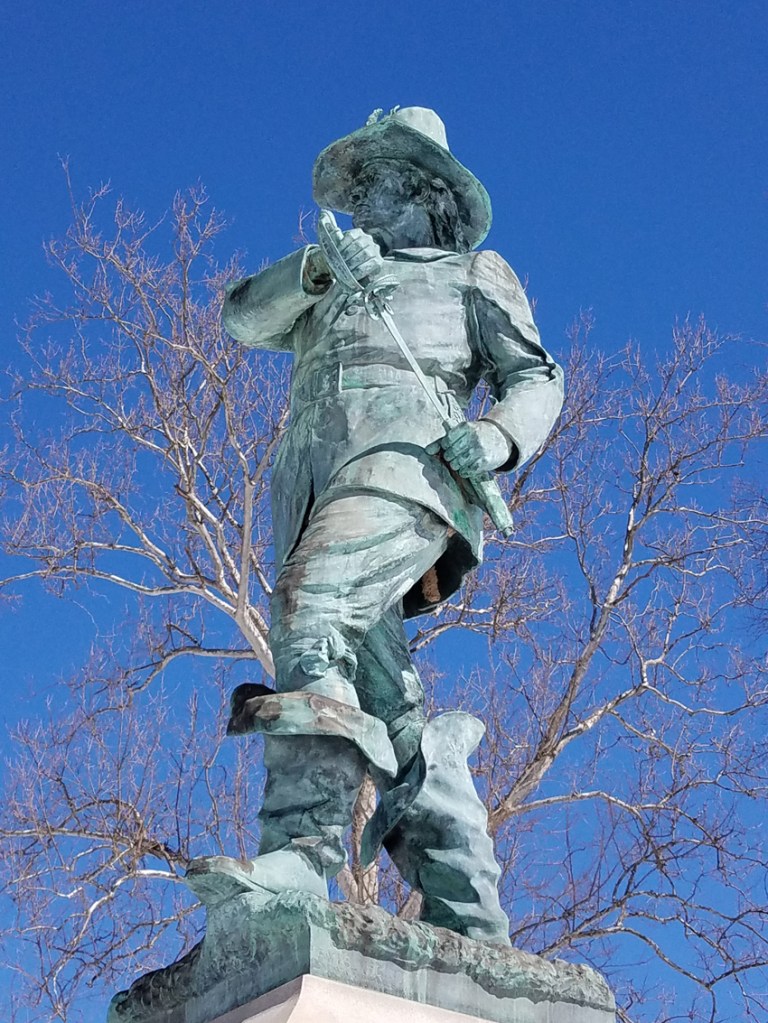
After the war, Captain Mason was promoted to major for his services, and was awarded numerous land grants. In 1645, his old commander from the Thirty Years War, Sir Thomas Fairfax – now the commander-in-chief of the parliamentary army in the English Civil War – sent a letter urging him to return to England and fight for the parliamentarian cause against King Charles. Mason would certainly have had a high command, as Fairfax was in desperate need of experienced military officers (Fairfax’s second-in-command at this time was Oliver Cromwell, who had no military training prior to the civil war). But Mason declined, instead taking command of Fort Saybrook in 1647 and becoming the chief military officer of the United Colonies of New England as well as Deputy Governor of Connecticut. In 1659, he, along with William Backus and many other of our ancestors, founded Norwich after purchasing the land from his old ally from the Pequot War, Uncas. In 1889 – during the “statue craze” that saw the erection of statues of Confederate generals all across the South – a statue of Mason was erected on the site of the Mystic Massacre, where it stood until 1996 until it was relocated to Mason’s hometown of Windsor.
Statue of John Mason
Uncas and the Mohegan tribe went from tributaries of the Pequots to becoming tributaries of the Connecticut Colony. The Mohegans remained the loyal allies of the colonists, siding with them against the Narragansetts and the majority of the indigenous tribes of New England in King Philip’s War forty years later – New England’s bloody second and final war between the Native Americans and the colonists. Uncas and Mason remained close to the end of their lives, and their ancestors retained ties for generations. The Mohegan Indian Reservation continues to exist today on the outskirts of Norwich, where the Mohegan Sun casino is located.
Our ancestors from Hartford, John Clark and William Pratt, did well for themselves after the war. They were likely personal friends of John Mason, for both of them ended up in Saybrook in the 1640s when Mason took command there, and Clark seems to have accompanied Mason to Norwich. Clark was one of the petitioners of the charter to King Charles II in 1662 that legally established the Connecticut Colony. Eventually he moved on to Milford, where he died in 1671. William Pratt stayed in Saybrook, becoming a lieutenant of the local militia in 1661 and representing Saybrook in the General Assembly of Connecticut in 23 sessions between 1666 and 1678. He also must have had personal ties to Uncas, as he was named in the will of Uncas’s third son, Attawanhood. As veterans of the Mystic campaign, both Clark and Pratt would have been considered heroes, and they received generous land grants in commemoration of their service.
As for the Pequots, they were essentially eliminated as a military and poltical force, but as a tribal and cultural entity they were more difficult to erase. The Pequots that were placed under the control of the Mohegans and Narragansetts were eventually removed from their custody and placed on two separate reservations in Connecticut, the Manshatucket Reservation and the Pawcatuck Reservation. By 1910, U.S. census records indicate there were only 66 Pequots remaining in Connecticut, though their numbers grew substantially over the next century. Today, the Mashantucket Pequot Reservation is home to the Mashantucket Pequot Museum and Research Center, as well as the Foxwoods Resort casino located about six miles east of Mohegan Sun, the casino run by the Mohegans – plastic casino chips replacing sea shells as currency in an economic competition for gambling dollars, a faint echo of their tribal enmity and warfare on the same lands from nearly four hundred years ago.
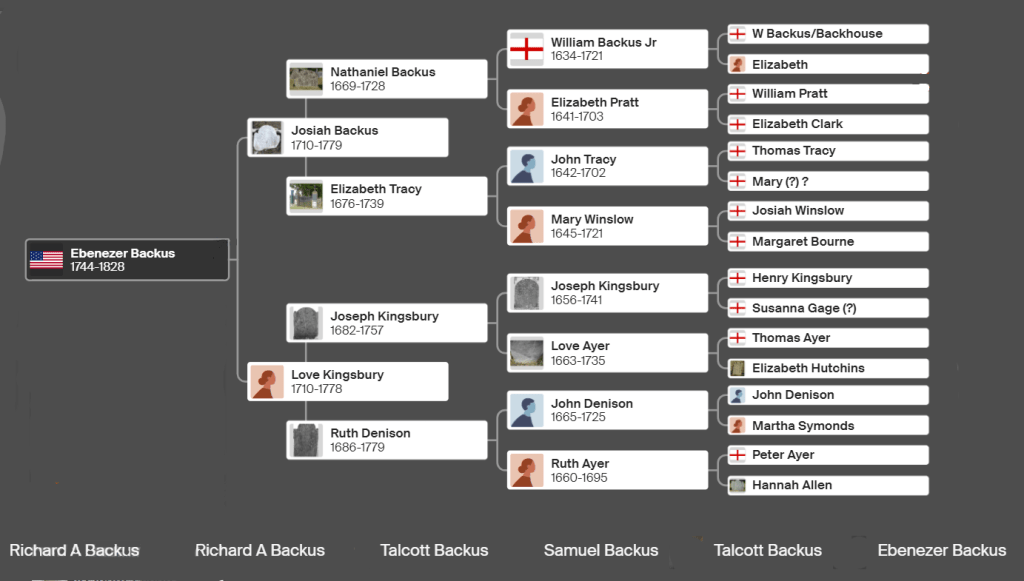
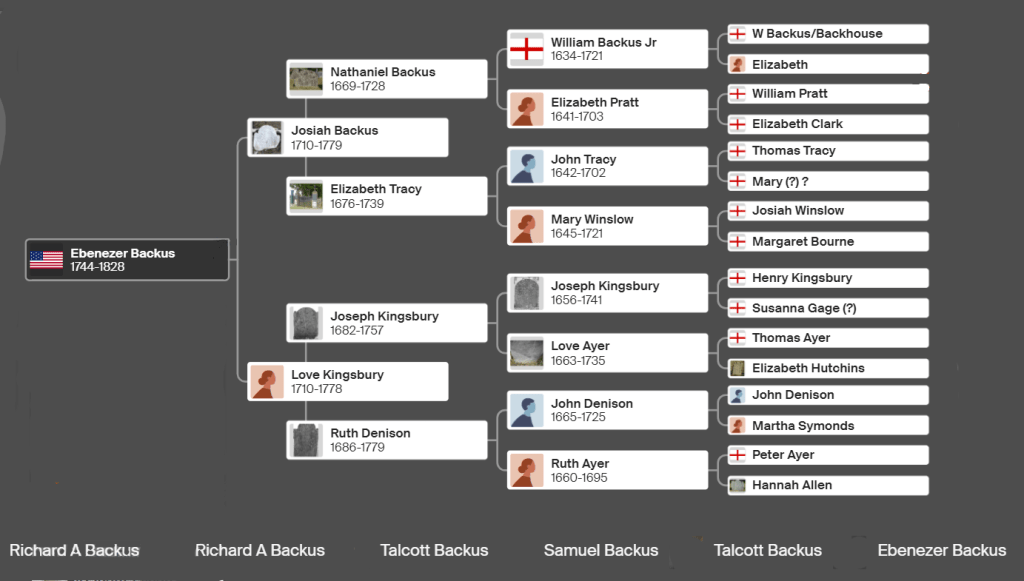
With the first coronation of an English monarch in nearly seventy years, I’ve been inspired to rouse myself out of inactivity to take a look at our own ancestral ties to the English monarchy – and we have some! Tracing one’s family back to European royalty seems to have been a preoccupation of many family genealogists a hundred years ago or so, and I’ve stumbled on many unsubstantiated – and some outright disproven – attempts to do so among people researching our own ancestors. Still, some of those ties do exist, and the most clearly delineated royal line connects to the Backus surname via a woman with the wonderful name of Love Kingsbury, who married Josiah Backus in Norwich, Connecticut in 1732 (Josiah being the great-grandson of our original ancestor William Backus).
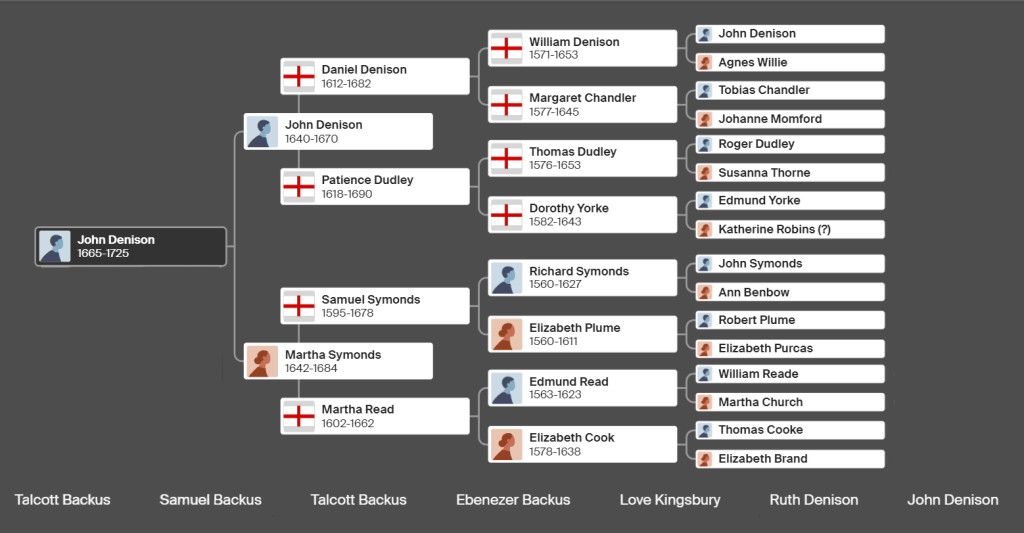
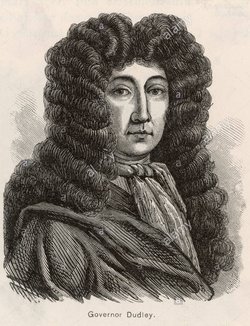
Through Love Kingsbury we can trace our way back to my generation’s 10th great grandmother Patience Dudley, who was descended from British royalty on both sides of her family. Her father was Thomas Dudley, the principal founder of Newtown, Massachusetts (which would become Cambridge) as well the governor of the Massachusetts Bay Colony a few times over. Dudley was already fifty-three years old when he arrived in Massachusetts in 1630, and he seems like a man from a bygone age even by seventeenth century colonial standards. Born in 1576 to the upper class, at the age of twenty he raised a company of soldiers to fight on the continent at the behest of Queen Elizabeth I for the Protestant cause in the French Wars of Religion.
After his military service Dudley became sympathetic to puritanism, and by 1616 was serving as the steward for Theophilus Clinton, the 4th Earl of Lincoln at his estate in Sempringham. Lincoln, a son in law of Viscount Saye, was one of the chief puritan political opponents of King Charles I, and it was at Sempringham where plans were initially hatched that would ultimately lead to the creation of the Massachusetts Bay Colony. When the eleven ships of the Winthrop Fleet set sail for North America in 1630, Thomas Dudley was on board the flagship Arabella as the Deputy Governor to John Winthrop. Dudley would himself eventually serve four one-year terms as Governor of Massachusetts and sign the charter that established Harvard College.
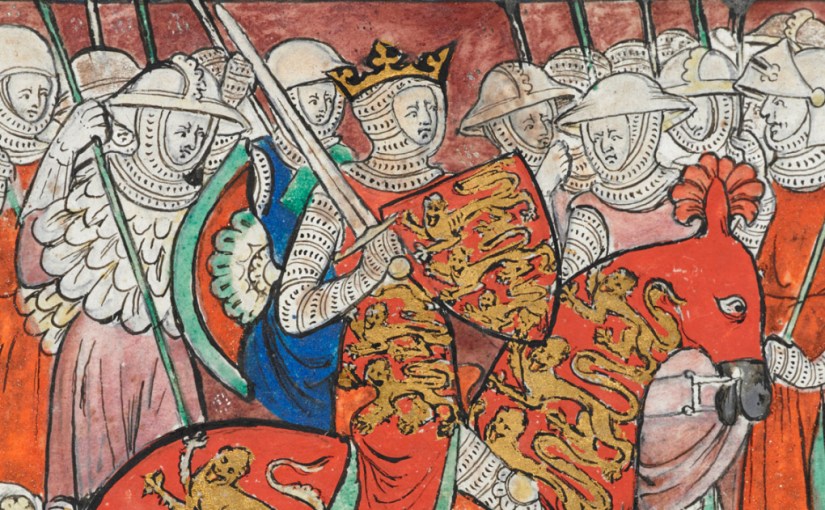
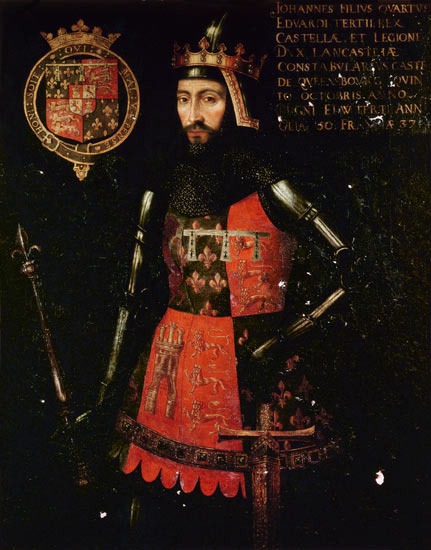
Dudley was most likely the grandson of Sir Henry Dudley, but direct evidence is lacking. Instead, we can trace his royal lineage through his mother, Susannah Thorne, who was a descendant of Richard FitzRoy, the “bastard” son of King John (FitzRoy, or “Son of the King ”, was the surname the Normans gave to the out-of-wedlock offspring of their monarchs). Thomas Dudley’s wife, Dorothy of Yorke, reveals more lines to the English crown. Through her we can make our way back to the fourteenth century and Joan de Greystoke, whose parents, John de Greystoke and Elizabeth de Ferrers, were both Anglo-Norman descendants of William the Conqueror. They share a common ancestor in Robert FitzRoy, the son of King Henry I, while Elizabeth de Ferrers also has a slightly more immediate connection to the royal family through her mother, Joan Beaufort, who was the daughter of John of Gaunt, the Duke of Lancaster and the third son of King Edward III. There are a couple of other connections as well, but, alas, none that will give any of us even a distant claim to the English crown, as all of these royal ancestors were born out of wedlock, and therefore officially removed from the line of succession.
John of Gaunt, the Duke of Lancaster
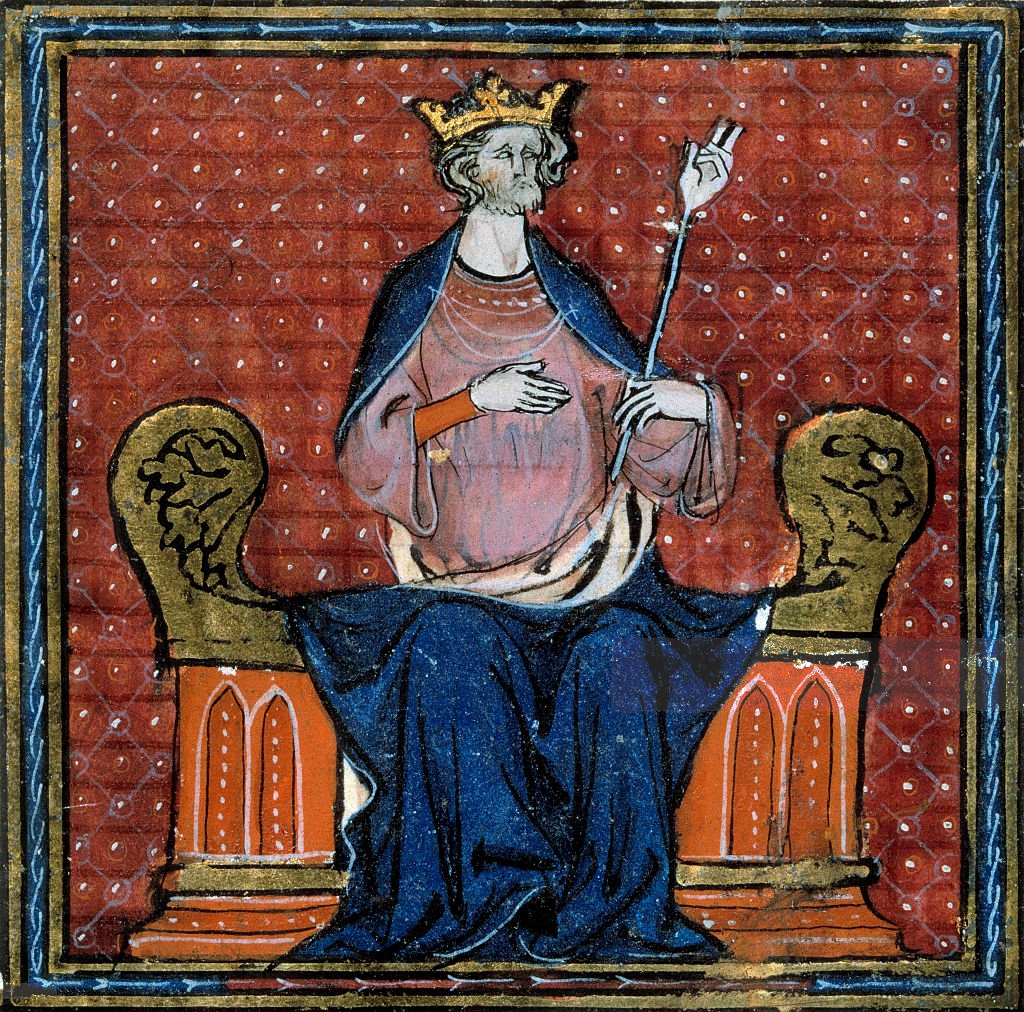
Still, all of these lines link us directly back to the Plantagenet dynasty of medieval England, and once you break into a royal line, royal matchmaking makes one a descendant of monarchs across both medieval Britain and Europe. Fancy a connection to the Celtic Britons? We can trace our lineage back to Llewelyn the Great, one of the last rulers of Wales who was actually Welsh. Wish you had Irish ancestry on St. Patrick’s Day? The Backuses are direct descendants of Diarmait mac Máel na mBó, the High King of Ireland before the Anglo-Norman invasion, and, further back, to Muiredach Muinderg, who legend tells us personally received the blessings of St. Patrick (the bad news being that our Irish descent comes from the union of Aoife MacMurrough and Richard de Clare, the 2nd Earl of Pembroke, who took a leading role in the English conquest of Ireland.) How about Scotland? King Henry I’s wife, Matilda, was the daughter of King Malcolm III of Scotland (of Shakespeare’s Macbeth fame). She was also the granddaughter of King Edmund “Ironside” – the Anglo Saxon king who fought valiantly against the Danish invasion of England – making us also direct descendants of King Alfred the Great. Feeling French? Edward III’s mother Isabella was the daughter of King Philip V, making us the descendants of a line of French kings going back to Hugh Capet. Other ancestors include Sviatoslav I, Grand Prince of Kiev, Bernard, King of Lombard Italy, Holy Roman Emperor Henry IV, King Bela II of Hungary, and Byzantine Emperor Romanos IV.
Hugh Capet
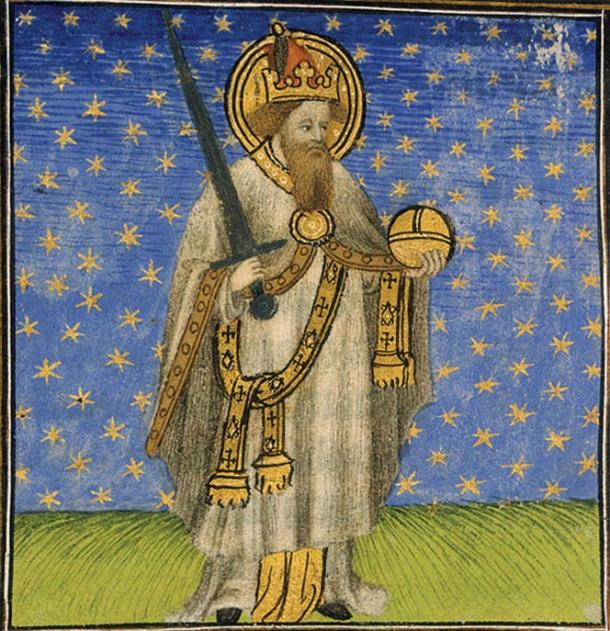
Ultimately, all roads lead back to Charlemagne – my generation’s 36th great grandfather – who was in many ways the founding father of all the noble houses of Europe. From Charlemagne we can go back even further, but not by much. Charlemagne’s great-great-great grandfather was Arnulf of Metz, a Frankish bishop born in 582, a little over a hundred years after the fall of the western Roman Empire. Though we can get tantalizingly close to the ancient world, the trail ends here. Arnulf was likely descended from the Roman senatorial class in some way, but there are no credibly documented European ancestral links through the darkness of the Dark Ages back into antiquity.
Emperor Charlemagne
Nowadays most of us are long past the idea that royalty confers any intrinsic benefit, or that being of “good birth” means anything. Statistically speaking, probably everyone of European descent is also a descendant of Charlemagne whether they can trace that lineage or not, and, to quote authors Jiri Louda and Michael Maclagan, “they are equally likely to be descended from the man who groomed his charger”. And can we really prove that all of these recorded parents are in fact the actual biological parents, and why does that even matter anyways?
For me, our royal lineages become interesting not because it confers any sort of status, but because of the journey through time one can embark on. Once you hit the Middle Ages, royal genealogies were the only ones that were recorded, so it’s basically all we’ve got when we go back that far. And there’s something rather incredible about seeing the expanse of history through forty or so generations laid out in front of you. From Arnulf and the dawn of the Middle Ages, we can follow our own familial line down through the coronation of Charlemagne, the Norman invasion of England, the Black Death, the Protestant Reformation, the European colonization of the New World, the formation of the United States, the Industrial Revolution, and onward into the 20th and 21st centuries. At each step of the way is a family dealing with the vicissitudes of life in the small pocket of time they inhabit while raising children who will do the same after them. This generational story will end for all of us some day, for some of us sooner rather than later, but will some of us have offspring that will lead to another forty generations, each with their own triumphs and tribulations?
In what is now East Lyme, Connecticut – located halfway between Saybrook and New London – runs a small stream called Bride Brook. The story of how Bride Brook got its name comes to us from Francis Caulkin’s History of Norwich first published in 1845.
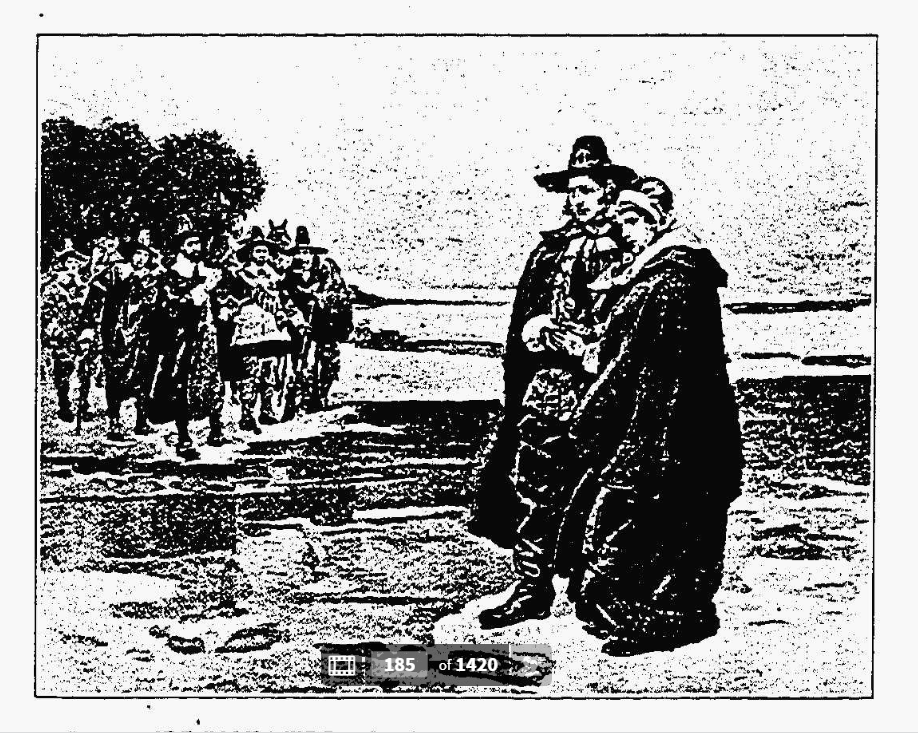
According to Caulkin, the small brook was the site of a wedding in the winter of 1646/47. Both the bride and groom were residents of Saybrook, where there wasn’t a qualified magistrate to marry the couple. By this point Saybrook had been absorbed by the Connecticut Colony, but a snow storm prevented travel between Saybrook and Hartford. So the couple sent word to no less a personage than Saybrook’s founder John Winthrop Jr., who had recently established neighboring New London (called Pequot at the time), asking him to perform the ceremony. That apparently created a legal problem, however – New London was initially established under the jurisdiction of the Massachusetts Bay Colony, and Winthrop felt he could not exercise his function as a magistrate in Connecticut territory.
Undeterred, Winthrop came up with the novel idea that he could marry the couple as long as he was in Massachusetts and they in Connecticut, so the parties met at a stream that was deemed the territorial boundary between the two colonies – the bride and groom on the west side of the stream, and Winthrop and his party on the east side. And so the marriage took place, the couple became Mr. and Mrs. Jonathan Rudd, and the stream was thenceforth dubbed Bride Brook. New London would be annexed to Connecticut a year later, but it seems the young colonial lovers couldn’t wait that long.
An artist’s conception from 1892 of the Bride Brook wedding
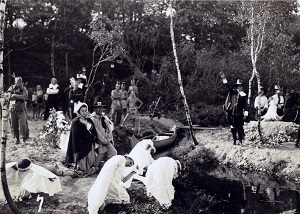
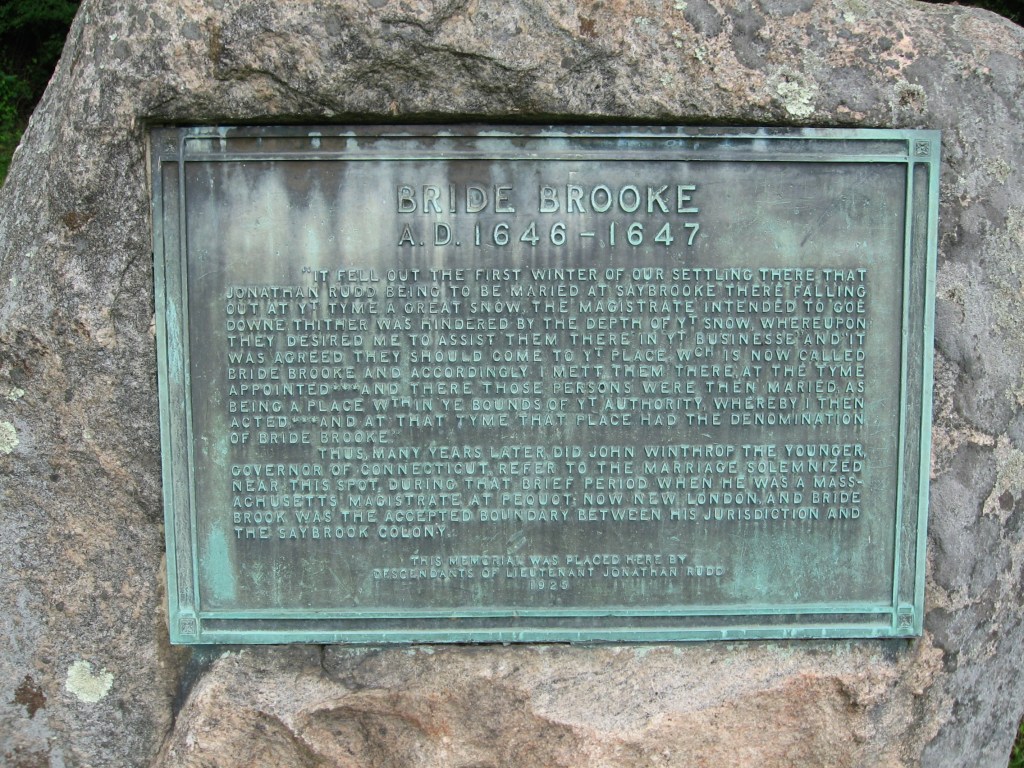
Since then, the romantic tale has captured the imagination of many local residents and Rudd descendants. The ceremony was re-enacted at Bride Brook in 1925 and again 1935, and a commemorative plaque was installed on the supposed site that still exists today. The story also inspired a 22-stanza romantic poem written by George Parsons Lathrop that appeared in the Atlantic in 1876. Lathrop paints an idyllic picture:
But “Snow lies light upon my heart! An thou,” said merry Jonathan Rudd, “Wilt wed me, winter shall depart, And love like spring for us shall bud.”
“Nay, how,” said Mary, “may that be? Nor minister nor magistrate Is here, to join us solemnly; And snow-banks bar us, every gate.”
“Winthrop at Pequot Harbor lies,” He laughed. And with the morrow’s sun He faced the deputy’s dark eyes: “How soon, sir, may the rite be done?”
“At Saybrook? There the power’s not mine,” Said he. “But at the brook we ’ll meet, That ripples down the boundary line; There you may wed, and Heaven shall see ’t.”
A Bride Brook Re-Enactment in 1935 (East Lyme Historical Society)
What would seem like merely a fanciful legend is bolstered by the fact that Winthrop himself retold the story in a 1672 deposition during an attempt to try to settle a boundary dispute between farmers from New London and Lyme over the right to cut hay in the disputed area. Despite Winthrop’s creative legal mind – or maybe because of it – Winthrop’s retelling of the Bride Brook wedding didn’t conclusively establish the boundary between the two towns. After subsequent petitions to the general court in Hartford failed to produce an agreement, the two sides finally decided to settle the matter by a fist fight between two picked champions from each town (Lyme won).
Bride Brook Marker
We don’t know very much about the groom, but the scant information we have of him doesn’t conjure up the traditional image of Puritan propriety. Who Jonathan Rudd’s parents were, where in England he came from, and the circumstances that brought him to Connecticut are all unknown – we first hear tell of him in April 1640 when he appears before a Hartford court with other youths for “being intimate” with a Mary Bronson. He then appears in the newly established New Haven colony, where he was fined twice in 1644, first for maintaining defective arms, and then for attending a drinking party.
Rudd next turns up in Saybrook, where he seems to have made a more respectable show of things. Shortly after his picturesque wedding in the snow in 1646/47, he is listed in a 1648 Saybrook town meeting as one of twelve men awarded land east of the river in what would become Old Lyme. The list isn’t in alphabetical order, and the two last names on it are William Backus and Jonathan Rudd – so if the list is ordered by lot assignment, this may indicate that the two were neighbors. Later, in 1652/53, Rudd is listed alongside Thomas Tracy as one of two lieutenants to Captain Mason responsible for fitting out six “great guns” for the defense of Saybrook.
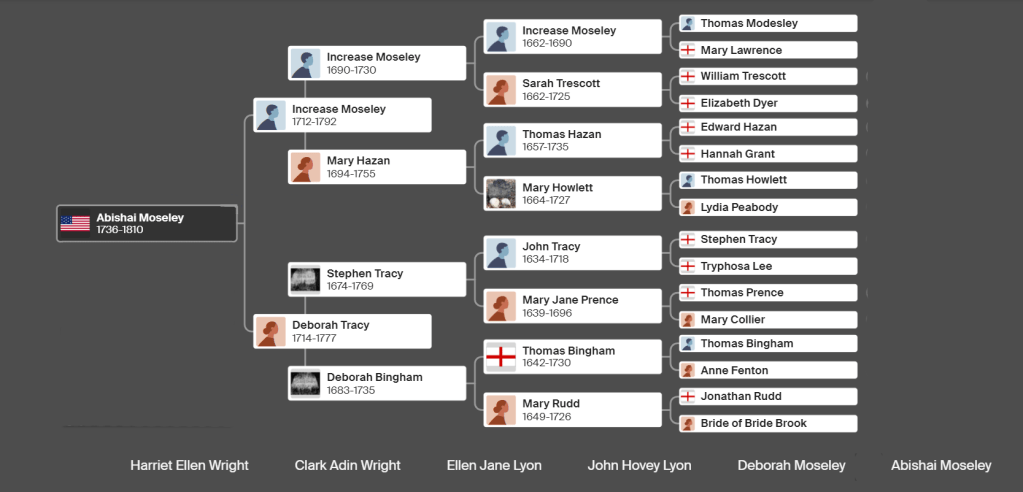
Both Mason and Tracy, as well as William Backus and four others among the twelve “Old Lyme” settlers, would go on to become first proprietors of Norwich in 1659. Given his connections to these men, it seems likely Rudd would have joined them in Norwich if he hadn’t died from unknown causes a year earlier. Connecticut probate records indicate that Norwich founder Rev. James Fitch took in his six children, so Rudd’s offspring ended up in Norwich all the same, and that’s where Rudd’s seventeen year-old daughter (and Wright ancestor) Mary would wed Thomas Bingham in 1666. Since Thomas Bingham was William Backus’ stepson and living in his household at some point after 1648 – also in the Old Lyme section of Saybrook and possibly next door – it seems likely the two knew each other growing up.
As for the bride of Bride Brook, we know virtually nothing about her. Tradition has it that she was named Mary, and some early genealogists claim she is Mary Metcalf, and others say she is Mary Burchard, but conclusive evidence is lacking. While the names of colonial men appeared in court records and town meetings as they went about their more public lives, colonial women would be home managing domestic affairs largely out of the public record, and when they did appear, it was as the wife of their husbands.
Even when their original surname is known, we don’t always know what happened to them. In colonial America, a married woman’s personal property came under the control of her husband, placing her in a system of almost completely dependency under the law. Married women generally did not write wills. We often learn that they have outlived their husband only by the husband’s bequest to them, but if the wife dies first there is sometimes no record of it, and in those cases we may only find out that the first wife has passed when the husband remarries. That wife, in turn, might outlive her husband, but if she were still of child-bearing age she would inevitably remarry and start the cycle again. At this point we might know her only by her previous husband’s surname, her own parentage having been effectively erased.
Those who died before their husbands often did so in childbirth. The chance of dying while giving birth in colonial New England is estimated as between one and one point five percent, but colonial women gave birth many times – upwards of ten births was not uncommon – and some estimates indicate that one in eight women died in such a way. We know the bride of Bride Brook had at least six children that survived infancy between 1647 and 1658, and then no more is known of her. She does not appear as a beneficiary in Jonathan Rudd’s will. Perhaps she died giving birth to the sixth child, or alongside a seventh.
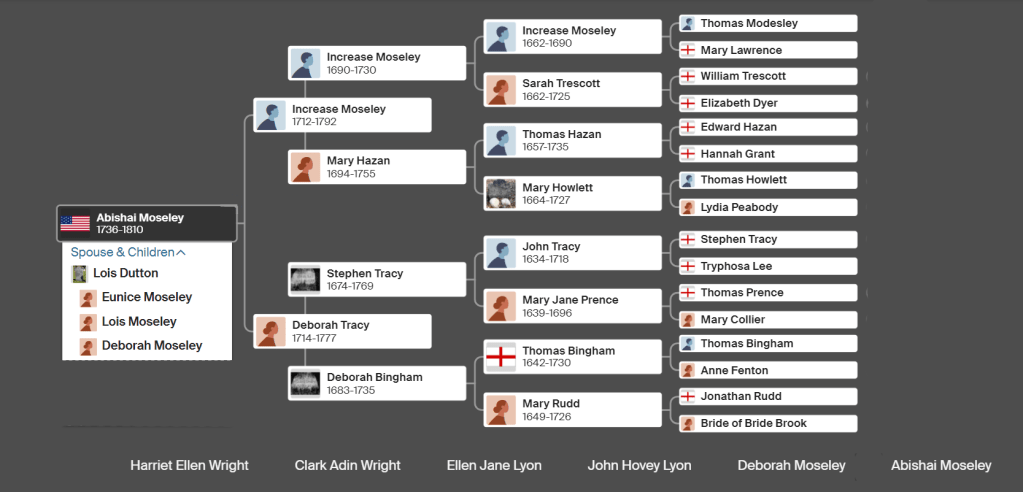
If so, her daughter Mary would be more fortunate. After three decades in Norwich, the Binghams helped settle Windham in 1693, and a gravestone inscription there indicates that Mary Bingham died in 1726 at the age of seventy-seven, ending sixty years of marriage (Thomas Bingham died four years later at the age of eighty-eight). Between the age of eighteen and forty-one, Mary Bingham gave birth to eleven children, all of whom lived to adulthood. The eighth, Deborah Bingham (b. 1683) would eventually lead to us.
With that, I’ll end with the final stanza of Lathrop’s poem commemorating the Bride of Bride Brook- and the men who remembered her by forgetting her:
“But none can tell us of that name More than the ‘Mary.’ Men still say ‘Bride Brook’ in honor of her fame; But all the rest has passed away.”
In 1966, a very distant Backus cousin named Reno Warburton Backus published The Backus Families of early New England, which remains to this day the most comprehensive genealogical survey of Backuses in North America. This slim green hardcover book traces the Backus clan back to our first immigrant ancestor, William Backus, and tells us some basic information about him. His family origins remain murky – we don’t know who his parents were – but according to Reno, family tradition has it that he was born in Norwich, England around 1600, and that he arrived in North America in 1637 on a ship called the Rainbow, settling first in Saybrook, Connecticut and then moving on to become one of the founders of Norwich, Connecticut in 1659. Backus family tradition has it that William Backus named the town after his place of origin.
More recent scholarship challenges some of these assumptions, namely, when he arrived and where in England he came from. To begin with, there doesn’t seem to be any record of William Backus in Saybrook (or anywhere in North America) until 1648, or any corroboration of a 1637 arrival date. There also doesn’t seem to be any concrete evidence of a ship called the Rainbow – the only references I’ve found to it are as the ship that brought William Backus to the colonies, which basically leads one back to where one started. Nor is there any record of a William Backus to be found in Norwich, England in the early 1600s.
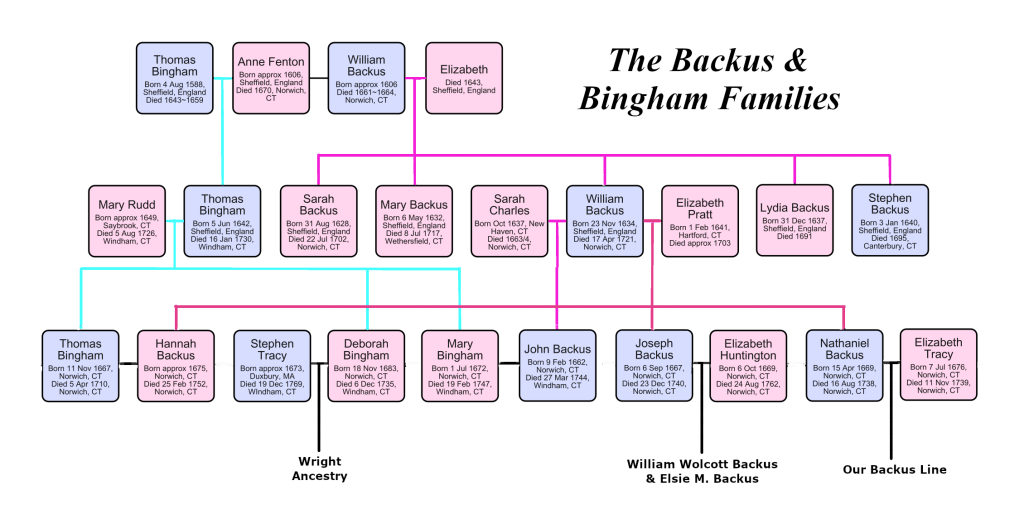
But we do find a William Backhouse many miles to the northwest in Sheffield. The discovery comes from Everett F. Bingham in 1988 while researching his own first immigrant ancestor, Anne Bingham. Anne Bingham would become William Backus’ second wife in the colonies, but as it turns out, they likely knew each other back in England beforehand.
William Backhouse of Sheffield
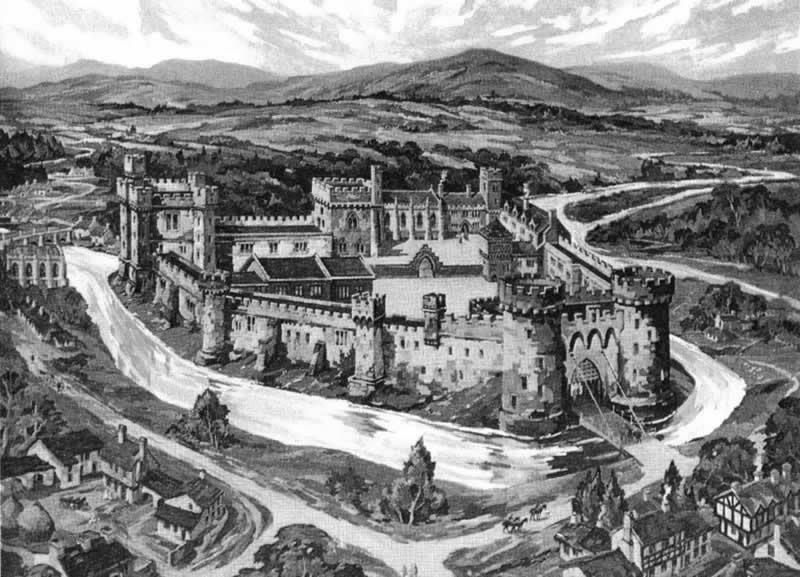
Located in South Yorkshire, the town of Sheffield sprung up around Sheffield Castle, a medieval stronghold built by the Norman conquerors in the 11th Century (and where Mary, Queen of Scots, was held prisoner centuries later). By the 1400s, Sheffield was known for one thing in particular – making knives – and by the 1620s, Sheffield was overseen by a trade guild known as “the Company of Cutlers in Hallamshire”. In 1624 we find a Thomas Bingham listed as a master cutler in Sheffield, and records from the St. Peters and Holy Trinity Parish Church indicate that he married Anne Fenton on July 6, 1631. We also find an apprentice cutler named William Backhouse attached to a William Nutt of Grimesthorpe (near Sheffield) who was “given his freedom” in 1627. He would then join Thomas Bingham as a member of the Sheffield Cutler’s Company in 1631.
An illustration of Sheffield Castle at the end of the 13th Century
If William Backhouse ended his apprenticeship at the traditional age of about 21 years old, we have an approximate birthdate for him in 1606 – shortly after the death of Elizabeth I at the dawn of England’s Jacobean age. We don’t know when William Backhouse married his first wife, Elizabeth, but we do find the births of the five children of William Backhouse in the Sheffield records whose names and birthdates – starting in 1628 and ending in 1642 – correspond with the names and ages of the children of William Backus of Saybrook and Norwich, Connecticut. If this isn’t indication enough that the William Backhouse of Sheffield is the same William Backus of Saybrook and Norwich, I will quote Everett Bingham with the final coup de grace from his article in volume 142 of the New England Historical Genealogical Register:
“There can be little doubt this William Backhouse is the William Backus of Saybrook, Conn because he used a unique “trademark” for his signature, which was a W directly over a B, likely used to “sign” his cutlery products. This same mark is found on papers he signed in England as well as on his will, in Connecticut.”
It seems logical to conclude then, that William Backhouse – soon to be known as William Backus on the other side of the Atlantic – did not arrive on a rainbow in 1637, but arrived with his family some time between 1643 – the year Yorkshire parish records indicate his wife Elizabeth passed away – and 1648 – the year his name first appears at a town meeting in Saybrook, Connecticut.
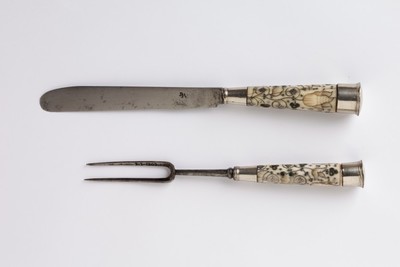
Knife and fork with ivory handles. Cutler’s mark: a letter crowned, Sheffield, late 17th century. Victoria and Albert Museum.
If our immigrant Backus ancestor did indeed leave England in the mid 1640s, he left at a tumultuous time in English history. In August 1642, after years of simmering tension between the monarchy and the parliament, England would erupt into a civil war that would last for the rest of the decade. Sheffield itself would change hands more than once, culminating in the final surrender of Sheffield Castle in 1644 to the Parliamentarians (it was demolished a few years later). Though civil war seems like a good enough reason to leave on its face, the departure of William Backus at this time poses something of a mystery in that few were emigrating to the colonies at this time. In fact, the so-called “Great Migration” of the 1630s all but ended with the outbreak of war, as more New England colonists were heading to England at this time to aid in the Parliamentarian cause than vice versa. So why did William Backus decide to go in the opposite direction to Saybrook at this time? One can only guess.
William Backus of Saybrook
Unlike the colonies in Virginia and Maryland to the south, New England adhered wholeheartedly to the parliamentarian cause, and Saybrook was a “Roundhead” bastion even by New England standards. In 1631, the Earl of Warwick granted a patent of lands that included a large portion of the present state of Connecticut to a number of English investors, chief among them were William Fiennes, Viscount Saye and Seal, and Robert Greville, also known as Lord Brooke. Saye and Brooke were both ardent Calvinists and leaders of the parliamentary opposition to Charles’ rule. For members of the opposition, the period of King Charles’ “personal rule” in the 1630s were grim ones, and it is in this period that scores of English Puritans fled to New England to start a better life. It was with the idea of creating a safe haven for themselves and their parliamentarian allies that the Saybrook project was undertaken. When civil war finally erupted, most of the patentees decided to stay in England and fight for the cause there: Lord Brooke himself would die at the hand of a royalist sniper during the Siege of Lichfield in 1643. Nevertheless, the people of Saybrook seemed to remember their original purpose as a safe haven long afterwards, and decades later Saybrook residents were still pointing out the plots that would have been allocated to Oliver Cromwell and John Pym.
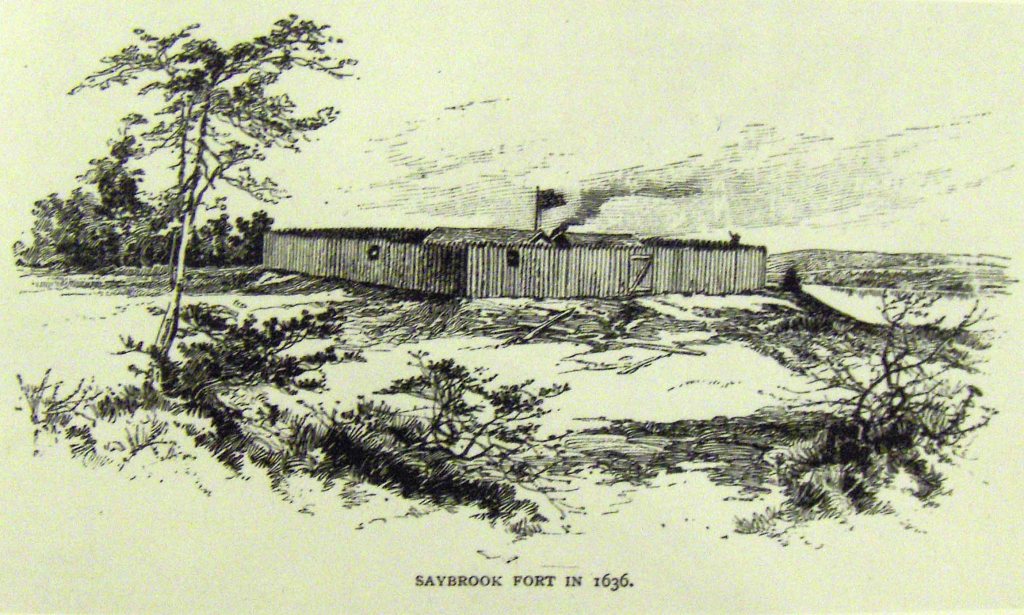
But in 1635, the English Civil War and the eventual victory of Cromwell’s New Model Army was far in the future, so Saye, Brooke, and the other patentees commissioned John Winthrop Jr. – the son of the governor of Massachusetts – to establish a new colony on the mouth of the Connecticut River where they could flee to if the going got rough. But the Dutch were already in the region – having formed a trade alliance with the native Pequots – and their original trading port at that location had been dubbed Zeebroeck, or “Seabrook”. The Dutch were already negotiating with the native tribes to create a more permanent settlement, but when a Dutch sloop arrived from New Amsterdam, the English were already there, and they had enough time and wherewithal to unload two cannons to dissuade the Dutch from pressing their claims. And so Seabrook became Saye-Brooke, eventually Saybrook, the first fortified European outpost on New England’s southern coast.
Even though some of its more eminent potential citizens decided to stay in England, it seems by the time William Backus got there in the mid 1640s, Saybrook was feeling a little cramped. In the first record of Backus in North America, a 1648 town meeting shows he was one of a number of settlers awarded land to be developed on the east side of the river in what would later become Old Lyme. He stayed there for about a decade, at which point he and a number of other Saybrook residents embarked on a new adventure: the founding of Norwich.
William Backus of Norwich
Led by Rev. James Fitch and Captain John Mason – the commander of the Connecticut troops that perpetuated what would become known as the Mystic Massacre during the Pequot War of the 1630s – a group of Saybrook residents that included William Backus founded the town of Norwich in 1659, located inland up the Thames River, after purchasing the land from the Mohegans. William Backus and his son of the same name are two of the 35 so-called original proprietors of Norwich, and we are direct descendants of 10 of them in all.
Also listed as one of the original proprietors of Norwich is a familiar name from Sheffield: Bingham. Before William Backus relocated his family from Saybrook to Norwich, his old friends from his Sheffield cutlery days – the Binghams – joined him in Saybrook. When exactly the Binghams traveled to Saybrook is unclear, though it had to be after Thomas and Anne’s youngest child, Mary, was baptized (and shortly thereafter buried) in Sheffield in 1648. What is clear is that Thomas Bingham himself never made it all the way there. Early Bingham genealogies take stock in a Bingham family tradition that Thomas died on the way during a crossing that took place in 1659. A more recent genealogy apparently notes “with ample proof, that Thomas Bingham died in 1649”, but not having direct access to this work, what this proof is remains unclear. Whenever the trip was made, Thomas Bingham dying en route would make some sense: it would seem like quite an undertaking for his widow to attempt on her own, as their eldest surviving son who made the journey – Thomas Bingham Jr. – would have only been sixteen in 1659 – the latest estimated departure date.
Either way, the recently widowed Anne Bingham arrived in Saybrook without a husband, but she didn’t stay that way for long. She married William Backus shortly before the two of them – along with his two sons, three daughters, and her son Thomas – all relocated to Norwich. They would most likely have been in their fifties at the time, so the motive for the union was unlikely the usual one of “begatting” more offspring. Was it some unrequited love kept hidden for years? More likely, the ties between the two families were close back in England, at least close enough that the Binghams followed the Backuses from Sheffield to Saybrook. Marrying the recently widowed Anne may have been the logical gesture of kinship when she arrived in this strange new world.
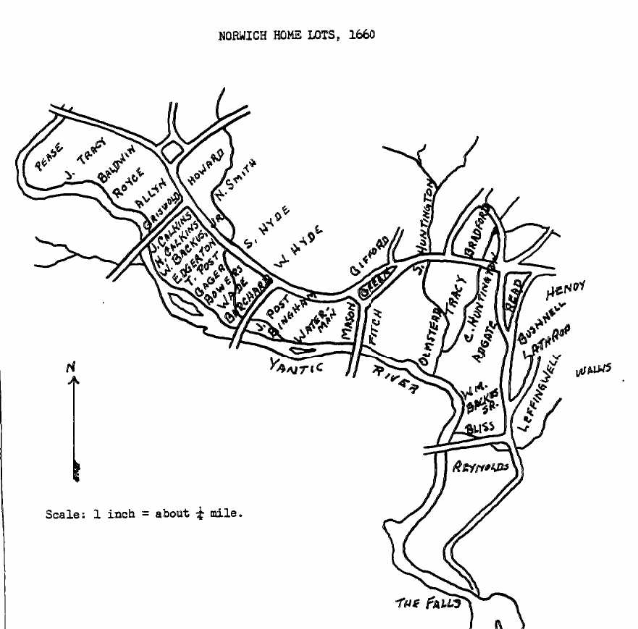
Norwich home lots of 1660, as presented in The Backus Families of early New EnglandNorwich in 2021
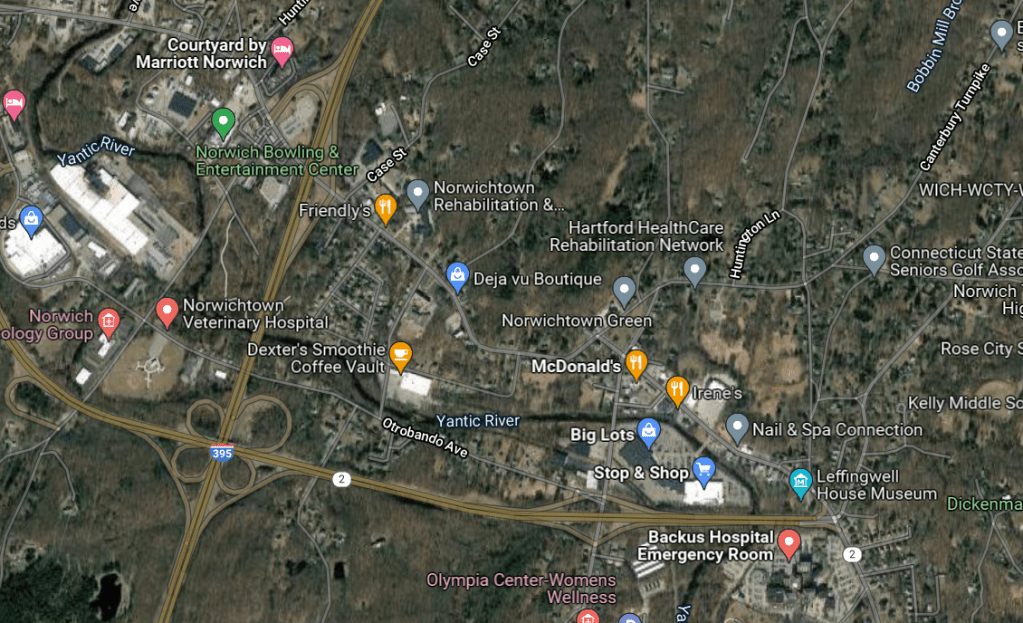
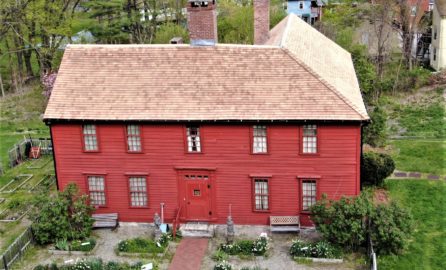
William Backus would not live in Norwich long; he died sometime between the signing of his will in 1661 and when it was proved in 1664, becoming the first of the original proprietors of Norwich to pass away. He signed his will with his “WB” – the literal trade mark that he used as a cutler in Sheffield – and his cutlery tools were bequeathed to his eldest son of the same name. His original home lot was signed over to his younger son, Stephen, who lived there until 1692, when he – along with Thomas Bingham – set out to become a first proprietor in a new town further north that would become Windham. Stephen Backus’ Norwich home was bought by Thomas Leffingwell 2nd, the son of one of the more celebrated Norwich founders. Leffingwell turned the building into the Leffingwell Inn, which became a meeting place for patriots during the Revolutionary War. Though it was rebuilt and expanded many times, apparently the original northeast corner built by Stephen Backus remains, and the building now serves as the home of the Leffingwell House Museum, owned and operated by the Society of the Founders of Norwich.
Leffingwell House
William Backus’ eldest son, William Backus 2nd – our direct ancestor – would stay in Norwich on his own home lot. While his father was the first of the original proprietors to pass away, William Backus 2nd would be the last: he died in 1721 at the age of 86. By the time of his death, “Junior” had become a resident of some means and stature, serving as a lieutenant in the Norwich militia, and having added at least 150 acres of land to his original six-acre allotment. We don’t know if he had a specific trade (or what it may have been), but his father’s life as a journeyman cutler in England would have been a distant childhood memory by the time of his death. What became of his father’s tools is not known – they don’t appear in his extensive list of items bequeathed in his will.
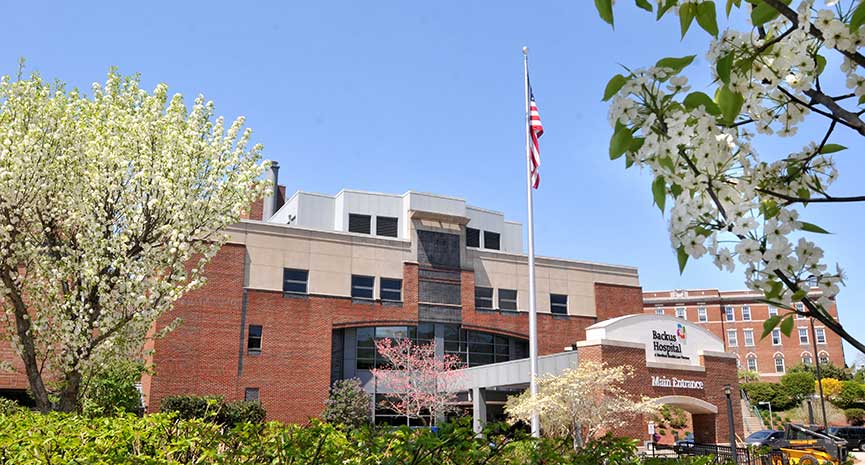
From Norwich, the Backuses would spread out across Connecticut first, and then the rest of the country, though some of William Backus’ ancestors remained in Norwich. Another William Backus – our original immigrant ancestor’s great-great-great grandson – founded the Backus Iron Works, which would go on to manufacture anchors and cannons for the Continental Navy during the American Revolution under his son Elijah. After the war, Elijah’s son, James, would travel back and forth supplying Marietta – Ohio’s first U.S. settlement – with manufactured goods from his family’s business, and he is said to have erected the first house there – so it is likely the settlement’s first structure (as well as many others) was put together by “Backus nails”. James’ son – William Wolcott Backus – also went back and forth from Norwich to Marietta (and many other Norwich Backuses ended up settling there) but he eventually returned permanently to Connecticut, where he used much of his fortune to found Backus Hospital, which still operates in Norwich today and sits a few hundred feet from the Leffingwell Museum (and William Backus’ original home lot.) From what I can tell, the last remaining Norwich Backus who continued an unbroken line of residents back to our original ancestor was Elsie M. Backus, who appears in Norwich in the 1940 U.S. census, but moved to New London with her mother Emily at some point before 1950. She passed away in 1995.
Backus Hospital
The Backuses would also retain their close ties with the Binghams for at least a generation – two of Thomas Bingham 2nd’s children, our original ancestor’s adult stepson, married two of William Backus 2nd’s children. Another of Thomas Bingham’s daughters, Deborah, married Stephen Tracy, and their great-great-great granddaughter, Ellen Jane Lyon, would marry a farmhand named Norman Wright in Colchester, Vermont in 1861. The granddaughter of that union, Harriet Wright, would marry another descendant of William Backus named Richard in 1936, making the Binghams some of our original immigrant ancestors on the Wright side of our family.
So, as it turns out, we are descendants of not just one cutler from Sheffield, but two.







 The Great Oak