
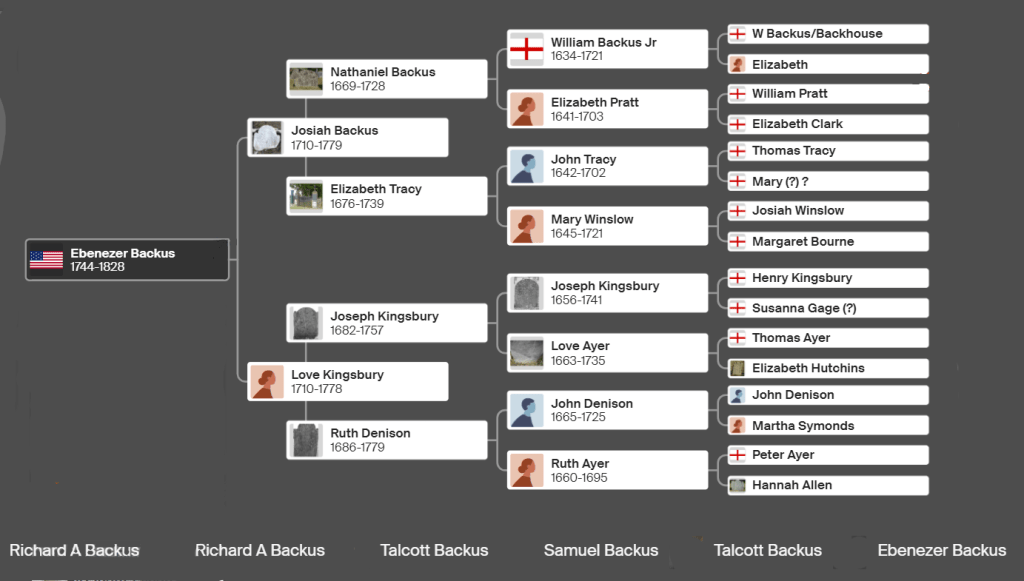
In 1966, a very distant Backus cousin named Reno Warburton Backus published The Backus Families of early New England, which remains to this day the most comprehensive genealogical survey of Backuses in North America. This slim green hardcover book traces the Backus clan back to our first immigrant ancestor, William Backus, and tells us some basic information about him. His family origins remain murky – we don’t know who his parents were – but according to Reno, family tradition has it that he was born in Norwich, England around 1600, and that he arrived in North America in 1637 on a ship called the Rainbow, settling first in Saybrook, Connecticut and then moving on to become one of the founders of Norwich, Connecticut in 1659. Backus family tradition has it that William Backus named the town after his place of origin.
More recent scholarship challenges some of these assumptions, namely, when he arrived and where in England he came from. To begin with, there doesn’t seem to be any record of William Backus in Saybrook (or anywhere in North America) until 1648, or any corroboration of a 1637 arrival date. There also doesn’t seem to be any concrete evidence of a ship called the Rainbow – the only references I’ve found to it are as the ship that brought William Backus to the colonies, which basically leads one back to where one started. Nor is there any record of a William Backus to be found in Norwich, England in the early 1600s.
But we do find a William Backhouse many miles to the northwest in Sheffield. The discovery comes from Everett F. Bingham in 1988 while researching his own first immigrant ancestor, Anne Bingham. Anne Bingham would become William Backus’ second wife in the colonies, but as it turns out, they likely knew each other back in England beforehand.
William Backhouse of Sheffield
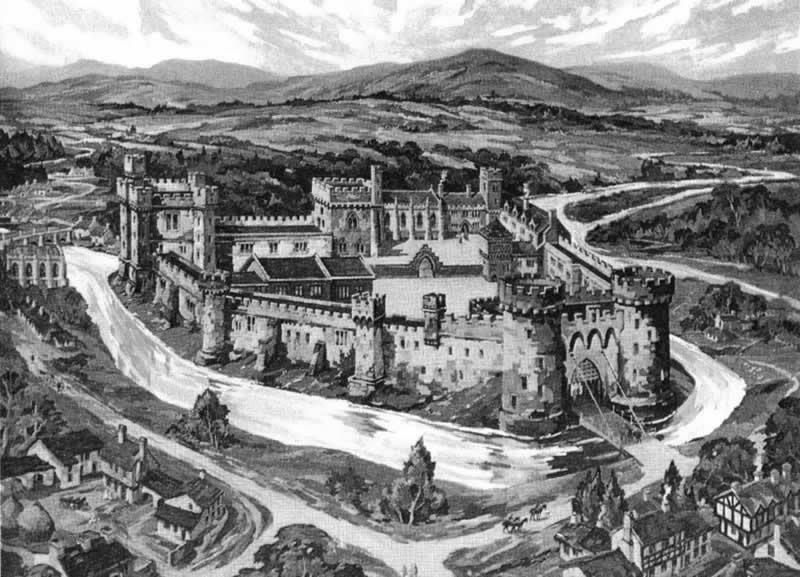
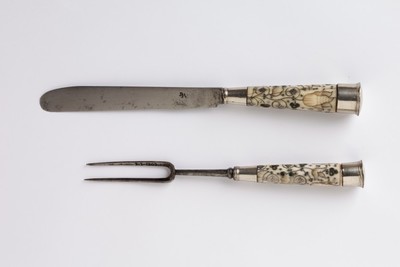
Located in South Yorkshire, the town of Sheffield sprung up around Sheffield Castle, a medieval stronghold built by the Norman conquerors in the 11th Century (and where Mary, Queen of Scots, was held prisoner centuries later). By the 1400s, Sheffield was known for one thing in particular – making knives – and by the 1620s, Sheffield was overseen by a trade guild known as “the Company of Cutlers in Hallamshire”. In 1624 we find a Thomas Bingham listed as a master cutler in Sheffield, and records from the St. Peters and Holy Trinity Parish Church indicate that he married Anne Fenton on July 6, 1631. We also find an apprentice cutler named William Backhouse attached to a William Nutt of Grimesthorpe (near Sheffield) who was “given his freedom” in 1627. He would then join Thomas Bingham as a member of the Sheffield Cutler’s Company in 1631.
If William Backhouse ended his apprenticeship at the traditional age of about 21 years old, we have an approximate birthdate for him in 1606 – shortly after the death of Elizabeth I at the dawn of England’s Jacobean age. We don’t know when William Backhouse married his first wife, Elizabeth, but we do find the births of the five children of William Backhouse in the Sheffield records whose names and birthdates – starting in 1628 and ending in 1642 – correspond with the names and ages of the children of William Backus of Saybrook and Norwich, Connecticut. If this isn’t indication enough that the William Backhouse of Sheffield is the same William Backus of Saybrook and Norwich, I will quote Everett Bingham with the final coup de grace from his article in volume 142 of the New England Historical Genealogical Register:
“There can be little doubt this William Backhouse is the William Backus of Saybrook, Conn because he used a unique “trademark” for his signature, which was a W directly over a B, likely used to “sign” his cutlery products. This same mark is found on papers he signed in England as well as on his will, in Connecticut.”
It seems logical to conclude then, that William Backhouse – soon to be known as William Backus on the other side of the Atlantic – did not arrive on a rainbow in 1637, but arrived with his family some time between 1643 – the year Yorkshire parish records indicate his wife Elizabeth passed away – and 1648 – the year his name first appears at a town meeting in Saybrook, Connecticut.
If our immigrant Backus ancestor did indeed leave England in the mid 1640s, he left at a tumultuous time in English history. In August 1642, after years of simmering tension between the monarchy and the parliament, England would erupt into a civil war that would last for the rest of the decade. Sheffield itself would change hands more than once, culminating in the final surrender of Sheffield Castle in 1644 to the Parliamentarians (it was demolished a few years later). Though civil war seems like a good enough reason to leave on its face, the departure of William Backus at this time poses something of a mystery in that few were emigrating to the colonies at this time. In fact, the so-called “Great Migration” of the 1630s all but ended with the outbreak of war, as more New England colonists were heading to England at this time to aid in the Parliamentarian cause than vice versa. So why did William Backus decide to go in the opposite direction to Saybrook at this time? One can only guess.
William Backus of Saybrook
Unlike the colonies in Virginia and Maryland to the south, New England adhered wholeheartedly to the parliamentarian cause, and Saybrook was a “Roundhead” bastion even by New England standards. In 1631, the Earl of Warwick granted a patent of lands that included a large portion of the present state of Connecticut to a number of English investors, chief among them were William Fiennes, Viscount Saye and Seal, and Robert Greville, also known as Lord Brooke. Saye and Brooke were both ardent Calvinists and leaders of the parliamentary opposition to Charles’ rule. For members of the opposition, the period of King Charles’ “personal rule” in the 1630s were grim ones, and it is in this period that scores of English Puritans fled to New England to start a better life. It was with the idea of creating a safe haven for themselves and their parliamentarian allies that the Saybrook project was undertaken. When civil war finally erupted, most of the patentees decided to stay in England and fight for the cause there: Lord Brooke himself would die at the hand of a royalist sniper during the Siege of Lichfield in 1643. Nevertheless, the people of Saybrook seemed to remember their original purpose as a safe haven long afterwards, and decades later Saybrook residents were still pointing out the plots that would have been allocated to Oliver Cromwell and John Pym.
But in 1635, the English Civil War and the eventual victory of Cromwell’s New Model Army was far in the future, so Saye, Brooke, and the other patentees commissioned John Winthrop Jr. – the son of the governor of Massachusetts – to establish a new colony on the mouth of the Connecticut River where they could flee to if the going got rough. But the Dutch were already in the region – having formed a trade alliance with the native Pequots – and their original trading port at that location had been dubbed Zeebroeck, or “Seabrook”. The Dutch were already negotiating with the native tribes to create a more permanent settlement, but when a Dutch sloop arrived from New Amsterdam, the English were already there, and they had enough time and wherewithal to unload two cannons to dissuade the Dutch from pressing their claims. And so Seabrook became Saye-Brooke, eventually Saybrook, the first fortified European outpost on New England’s southern coast.
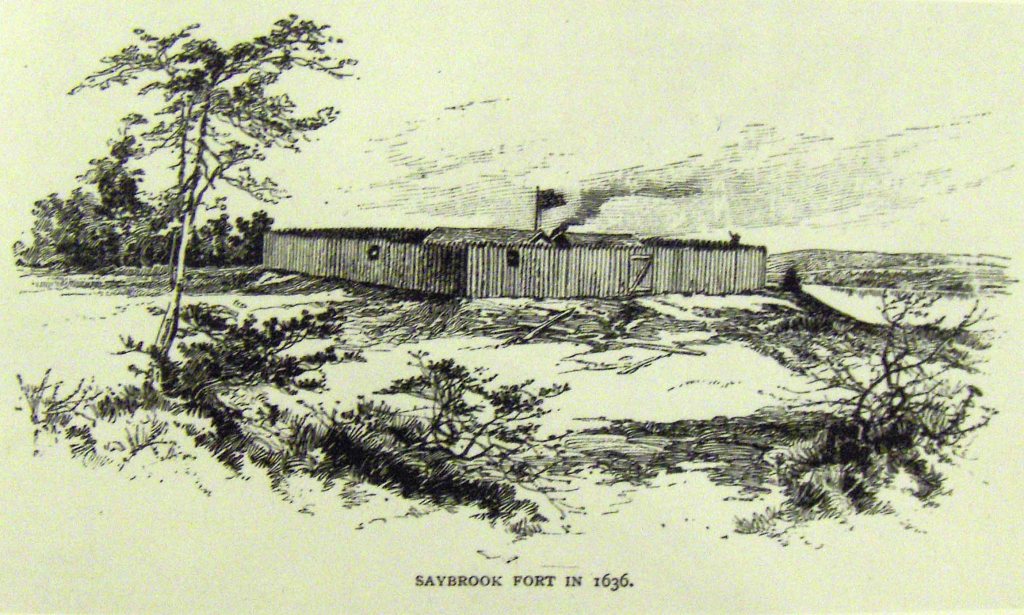
Even though some of its more eminent potential citizens decided to stay in England, it seems by the time William Backus got there in the mid 1640s, Saybrook was feeling a little cramped. In the first record of Backus in North America, a 1648 town meeting shows he was one of a number of settlers awarded land to be developed on the east side of the river in what would later become Old Lyme. He stayed there for about a decade, at which point he and a number of other Saybrook residents embarked on a new adventure: the founding of Norwich.
William Backus of Norwich
Led by Rev. James Fitch and Captain John Mason – the commander of the Connecticut troops that perpetuated what would become known as the Mystic Massacre during the Pequot War of the 1630s – a group of Saybrook residents that included William Backus founded the town of Norwich in 1659, located inland up the Thames River, after purchasing the land from the Mohegans. William Backus and his son of the same name are two of the 35 so-called original proprietors of Norwich, and we are direct descendants of 10 of them in all.
Also listed as one of the original proprietors of Norwich is a familiar name from Sheffield: Bingham. Before William Backus relocated his family from Saybrook to Norwich, his old friends from his Sheffield cutlery days – the Binghams – joined him in Saybrook. When exactly the Binghams traveled to Saybrook is unclear, though it had to be after Thomas and Anne’s youngest child, Mary, was baptized (and shortly thereafter buried) in Sheffield in 1648. What is clear is that Thomas Bingham himself never made it all the way there. Early Bingham genealogies take stock in a Bingham family tradition that Thomas died on the way during a crossing that took place in 1659. A more recent genealogy apparently notes “with ample proof, that Thomas Bingham died in 1649”, but not having direct access to this work, what this proof is remains unclear. Whenever the trip was made, Thomas Bingham dying en route would make some sense: it would seem like quite an undertaking for his widow to attempt on her own, as their eldest surviving son who made the journey – Thomas Bingham Jr. – would have only been sixteen in 1659 – the latest estimated departure date.
Either way, the recently widowed Anne Bingham arrived in Saybrook without a husband, but she didn’t stay that way for long. She married William Backus shortly before the two of them – along with his two sons, three daughters, and her son Thomas – all relocated to Norwich. They would most likely have been in their fifties at the time, so the motive for the union was unlikely the usual one of “begatting” more offspring. Was it some unrequited love kept hidden for years? More likely, the ties between the two families were close back in England, at least close enough that the Binghams followed the Backuses from Sheffield to Saybrook. Marrying the recently widowed Anne may have been the logical gesture of kinship when she arrived in this strange new world.
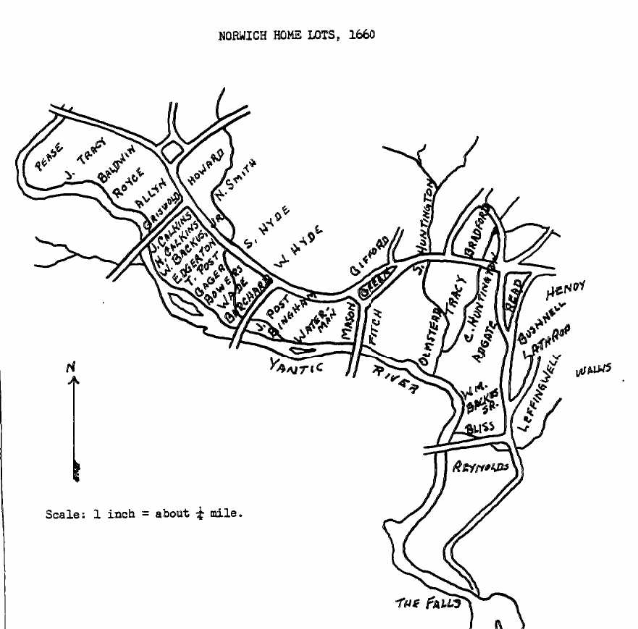
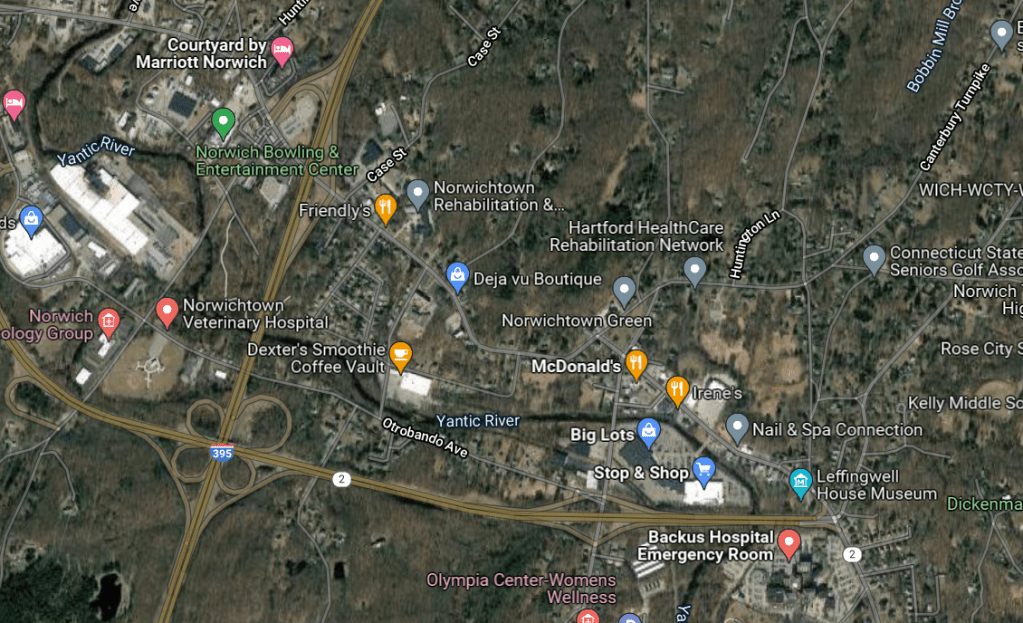
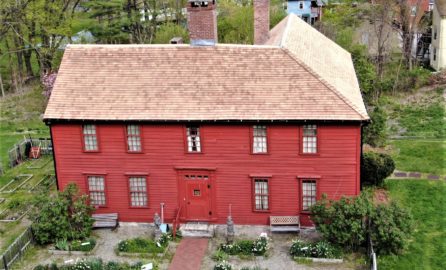
William Backus would not live in Norwich long; he died sometime between the signing of his will in 1661 and when it was proved in 1664, becoming the first of the original proprietors of Norwich to pass away. He signed his will with his “WB” – the literal trade mark that he used as a cutler in Sheffield – and his cutlery tools were bequeathed to his eldest son of the same name. His original home lot was signed over to his younger son, Stephen, who lived there until 1692, when he – along with Thomas Bingham – set out to become a first proprietor in a new town further north that would become Windham. Stephen Backus’ Norwich home was bought by Thomas Leffingwell 2nd, the son of one of the more celebrated Norwich founders. Leffingwell turned the building into the Leffingwell Inn, which became a meeting place for patriots during the Revolutionary War. Though it was rebuilt and expanded many times, apparently the original northeast corner built by Stephen Backus remains, and the building now serves as the home of the Leffingwell House Museum, owned and operated by the Society of the Founders of Norwich.
William Backus’ eldest son, William Backus 2nd – our direct ancestor – would stay in Norwich on his own home lot. While his father was the first of the original proprietors to pass away, William Backus 2nd would be the last: he died in 1721 at the age of 86. By the time of his death, “Junior” had become a resident of some means and stature, serving as a lieutenant in the Norwich militia, and having added at least 150 acres of land to his original six-acre allotment. We don’t know if he had a specific trade (or what it may have been), but his father’s life as a journeyman cutler in England would have been a distant childhood memory by the time of his death. What became of his father’s tools is not known – they don’t appear in his extensive list of items bequeathed in his will.
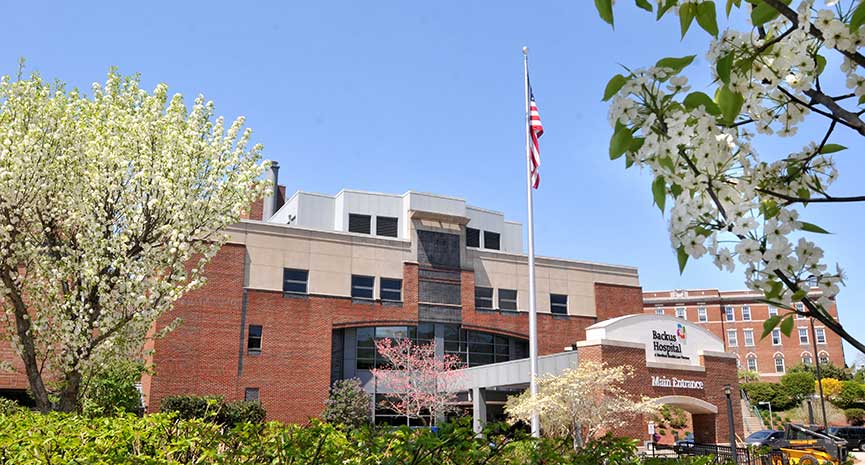
From Norwich, the Backuses would spread out across Connecticut first, and then the rest of the country, though some of William Backus’ ancestors remained in Norwich. Another William Backus – our original immigrant ancestor’s great-great-great grandson – founded the Backus Iron Works, which would go on to manufacture anchors and cannons for the Continental Navy during the American Revolution under his son Elijah. After the war, Elijah’s son, James, would travel back and forth supplying Marietta – Ohio’s first U.S. settlement – with manufactured goods from his family’s business, and he is said to have erected the first house there – so it is likely the settlement’s first structure (as well as many others) was put together by “Backus nails”. James’ son – William Wolcott Backus – also went back and forth from Norwich to Marietta (and many other Norwich Backuses ended up settling there) but he eventually returned permanently to Connecticut, where he used much of his fortune to found Backus Hospital, which still operates in Norwich today and sits a few hundred feet from the Leffingwell Museum (and William Backus’ original home lot.) From what I can tell, the last remaining Norwich Backus who continued an unbroken line of residents back to our original ancestor was Elsie M. Backus, who appears in Norwich in the 1940 U.S. census, but moved to New London with her mother Emily at some point before 1950. She passed away in 1995.
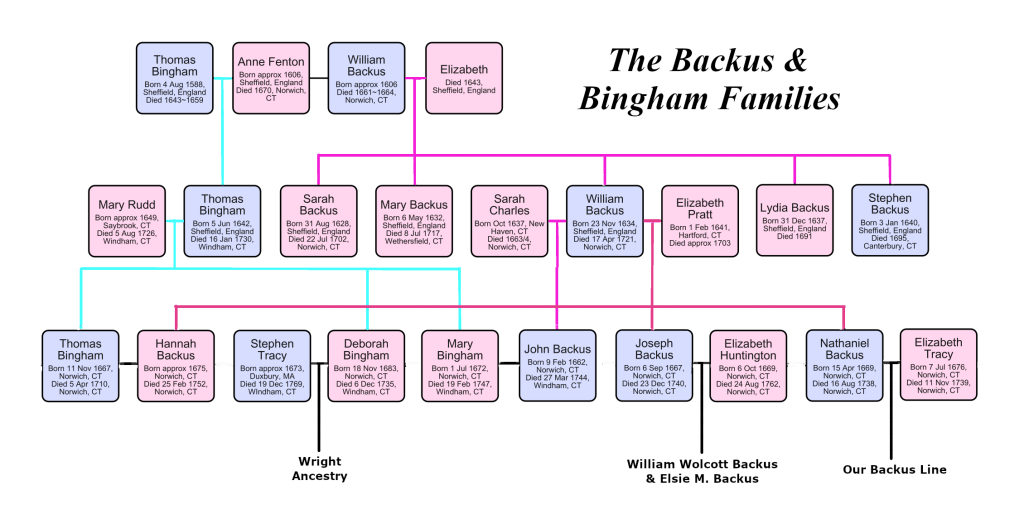
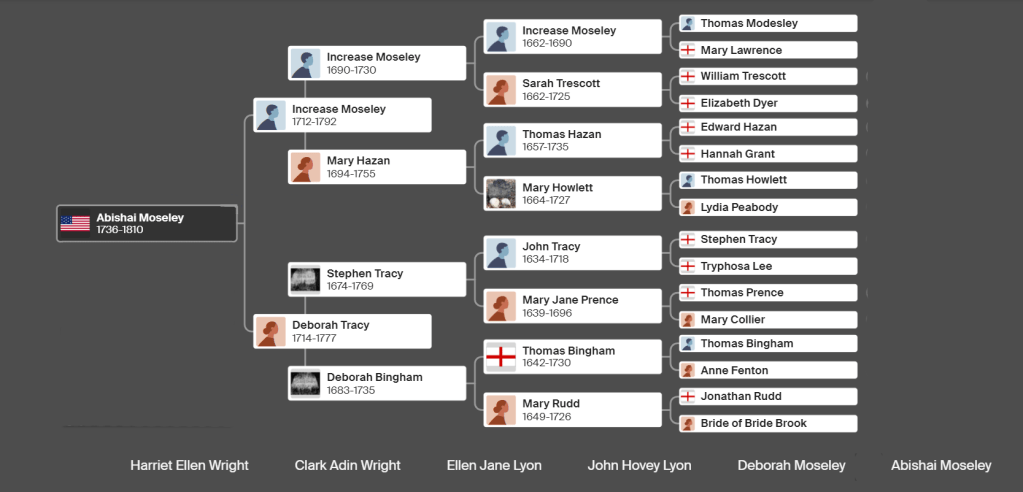
The Backuses would also retain their close ties with the Binghams for at least a generation – two of Thomas Bingham 2nd’s children, our original ancestor’s adult stepson, married two of William Backus 2nd’s children. Another of Thomas Bingham’s daughters, Deborah, married Stephen Tracy, and their great-great-great granddaughter, Ellen Jane Lyon, would marry a farmhand named Norman Wright in Colchester, Vermont in 1861. The granddaughter of that union, Harriet Wright, would marry another descendant of William Backus named Richard in 1936, making the Binghams some of our original immigrant ancestors on the Wright side of our family.
So, as it turns out, we are descendants of not just one cutler from Sheffield, but two.
 The Great Oak
Good morning – my name is Arthur Young. My 1Oth great grandfather was Thomas Bingham born 4 Aug 1588 -master cutler of Scheffield England. I am descended from his son the Deacon Thomas Bingham who was the first Bingham to come to America.
I am a member of the Founders of Norwich.
Thank you for the great history of the Backus family – William Backus born 1634 was also my 10 great grandfather.
Art Young – 54 Devon Road Delmar, NY 12054
LikeLike
Thanks so much for reading. Glad you enjoyed it, and nice to meet a distant cousin!
LikeLike